Separation rationale, ratio control & filling
Six consequences of putting two formulas in one bottle.
A dual-chamber bottle exists for two reasons: because the formulas cannot be premixed without degrading, or because the customer should see two phases and a fixed ratio. Both are good reasons. Neither changes that the pack now needs two fills, two compatibility assessments and a dispenser that draws from both.
Separation is either chemical or theatrical, and both are legitimate
Some pairings, such as certain vitamin C forms with a peptide, or an oxidizer with its activator, genuinely cannot be premixed and stay stable. Equally, a visible two-tone bottle communicates a dual action that customers understand instantly. Knowing which reason applies matters, because a chemical separation demands closure integrity that a visual one does not.
The chamber volumes fix the ratio permanently
Whatever proportion the two chambers hold is the ratio the customer receives, and it cannot be adjusted after tooling. That makes the formulation and the mold decision a single conversation, and a formula change that moves the ratio means new glass rather than a new fill setting.
The dispenser has to draw from both at once
A dual-chamber pump takes from each side simultaneously and combines at the nozzle, which requires balanced flow. Different viscosities pull at different rates, so the pump has to be matched to the pair rather than to either one. That matching is the most common technical failure in this format.
Filling doubles the work
Two products means two fill stations, two cleaning routines and a changeover between them, on a bottle that has to be presented correctly to each. Small-batch programs frequently underestimate this, and it is worth confirming with the filler before the glass is tooled rather than afterwards.
The divider is a structural feature
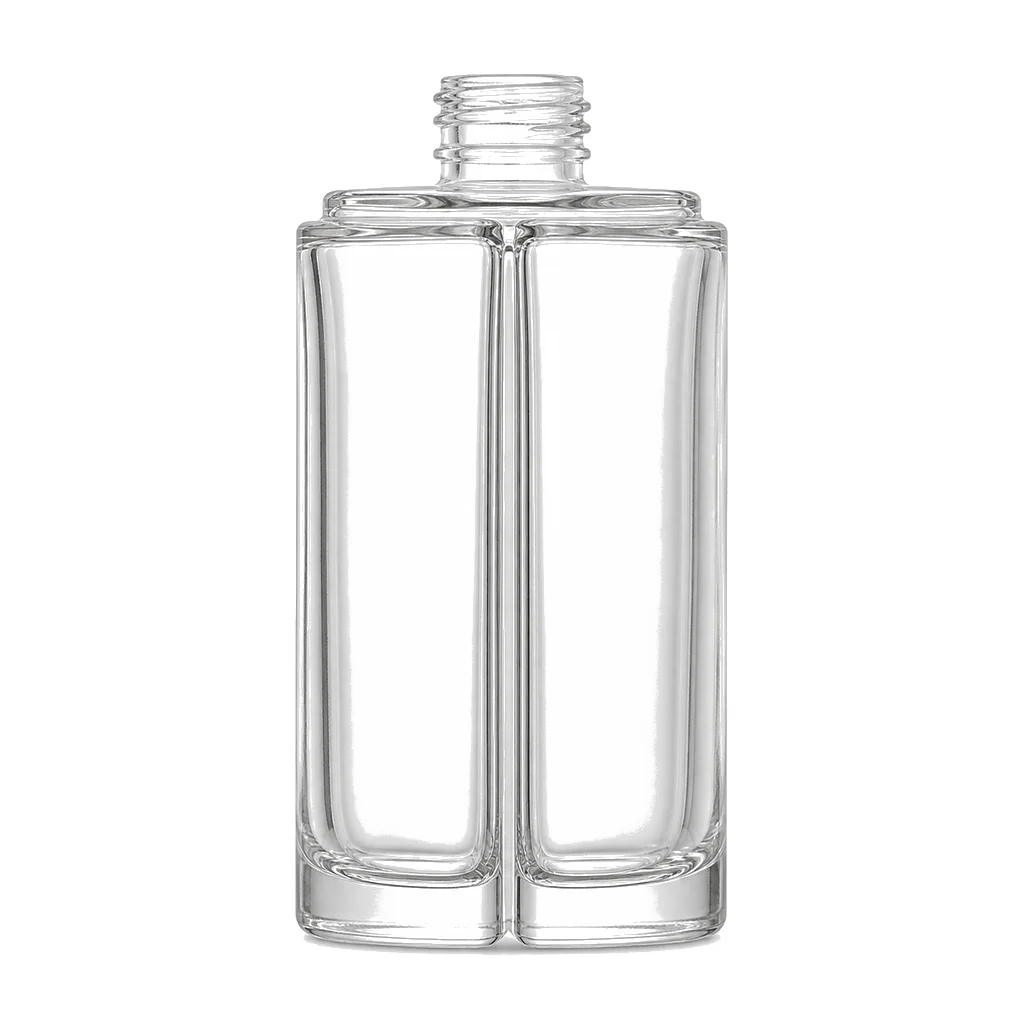
The wall between chambers is molded glass that has to hold both fills without leaking between them, survive transit and take the thermal stresses of filling. A hairline flaw there cross-contaminates both formulas silently, so it deserves inspection attention that a plain wall would not require.
Two chambers means two fill lines, and they have to look equal
Even where the formulation ratio is deliberately uneven, a visible difference between the two levels reads as a filling fault. Chamber geometry is designed so that the intended ratio presents as balanced, and that is checked on the filled bottle rather than calculated.