Fade control, process routes & batch matching
Six things that decide whether a gradient looks deliberate.
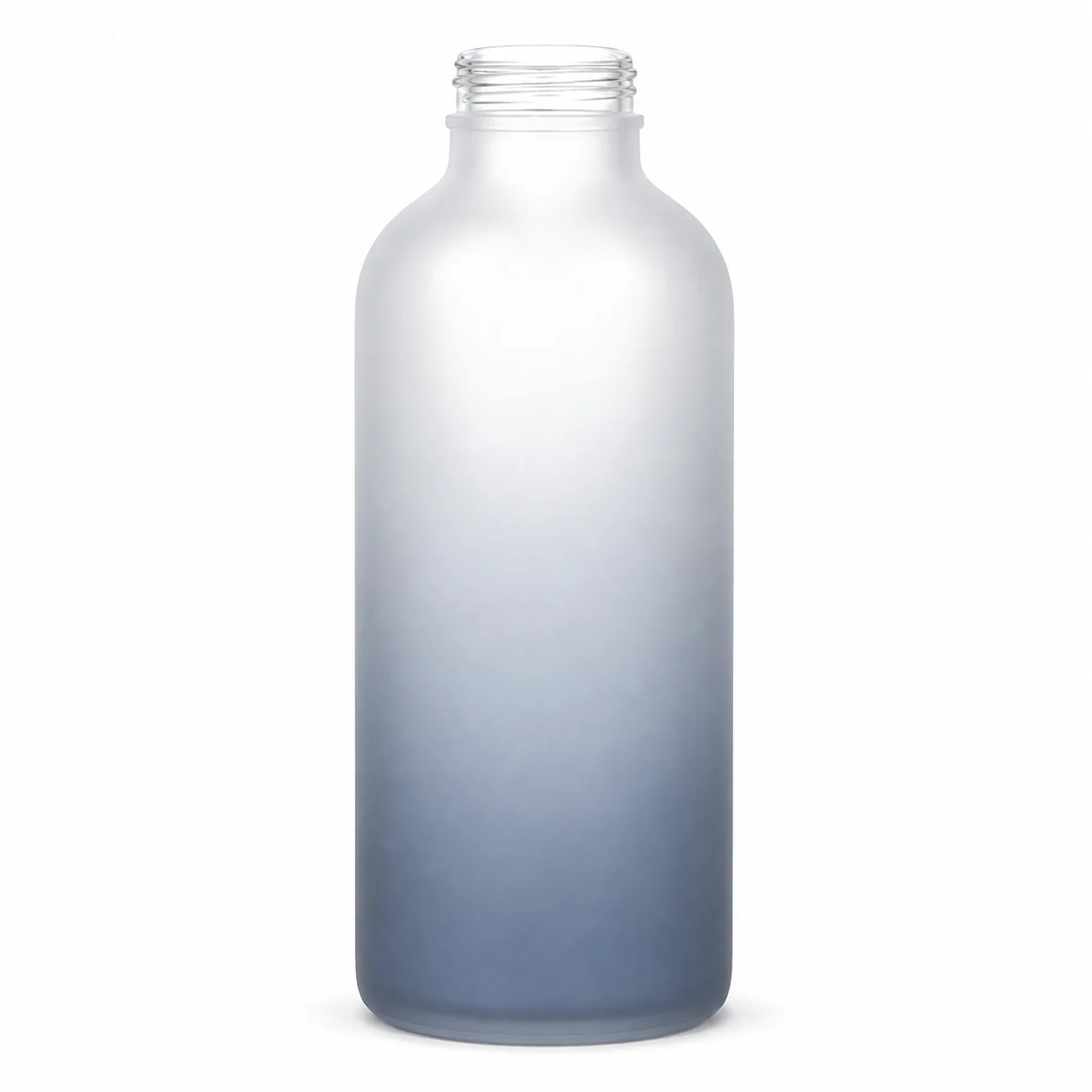
A gradient bottle is easy to describe and hard to reproduce. Full frosting and plain glass are both straightforward; a controlled fade between them means holding a transition in the same place, over the same distance, on every unit. That repeatability, rather than the finish itself, is what a gradient program is buying.
The transition zone is where quality is judged
Customers see two bottles side by side on a shelf and compare the height at which the frost begins and how quickly it clears. A fade that starts a centimeter higher on one unit reads as a fault, even though both bottles are individually attractive. Consistency across a run is the specification, not the appearance of one sample.
Etched and sprayed gradients differ in more than cost
An acid-etched fade is in the glass and cannot wear, but graduating an etch is harder to control than graduating a spray. A sprayed gradient is easier to modulate and can be matched to a color, and it is a coating that has to survive handling and any decoration applied over it. Neither is automatically the right route.
Approval needs limit samples, not a drawing
A gradient cannot be specified as a dimension. Approval works by agreeing physical samples at the acceptable extremes — earliest and latest fade start, sharpest and softest transition — and accepting the range between them. Approving from a rendering or a single perfect bottle guarantees a dispute at first production.
The clear section is doing a practical job
Unlike a fully frosted bottle, a gradient leaves part of the wall transparent, so the customer can still see the fill level and the product's color. That is a genuine functional benefit and it argues for placing the clear section where the level is most useful to read rather than purely where the design prefers it.
Labels have to sit in one zone or cross the fade deliberately
A label spanning the transition looks accidental unless the artwork is designed for it, since the background behind it changes. Either the label sits entirely within the frosted or the clear region, or the design acknowledges the fade. Deciding that before artwork saves a redesign after the first sample arrives.
Frost and adhesive do not agree, so the label position is decided early
Etched and sprayed surfaces both hold labels less securely than plain glass, and a label bridging a fade sits partly on each. Placing the label wholly within the clear zone, or specifying an adhesive proved on the actual finish, is settled before artwork is drawn.