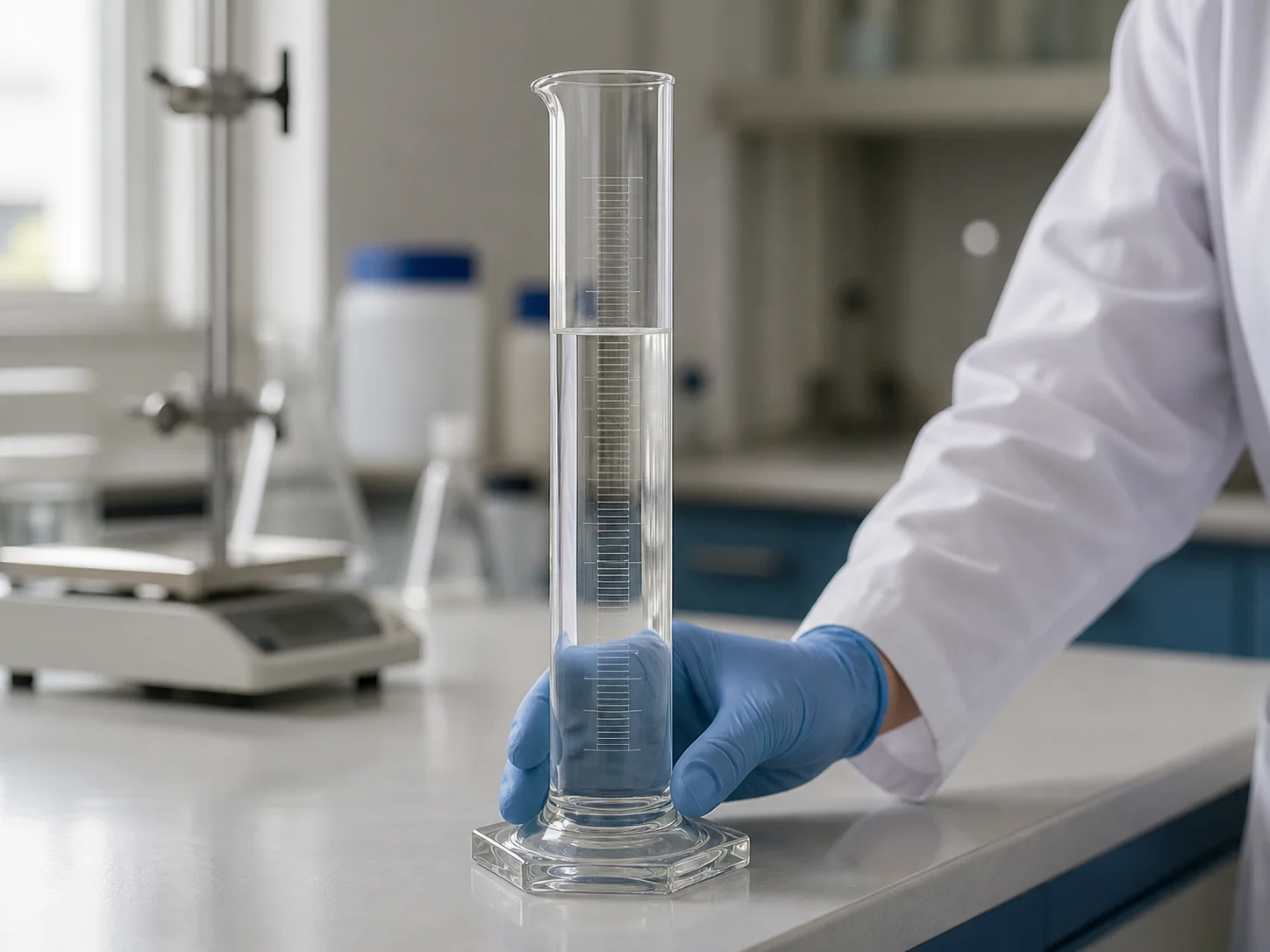
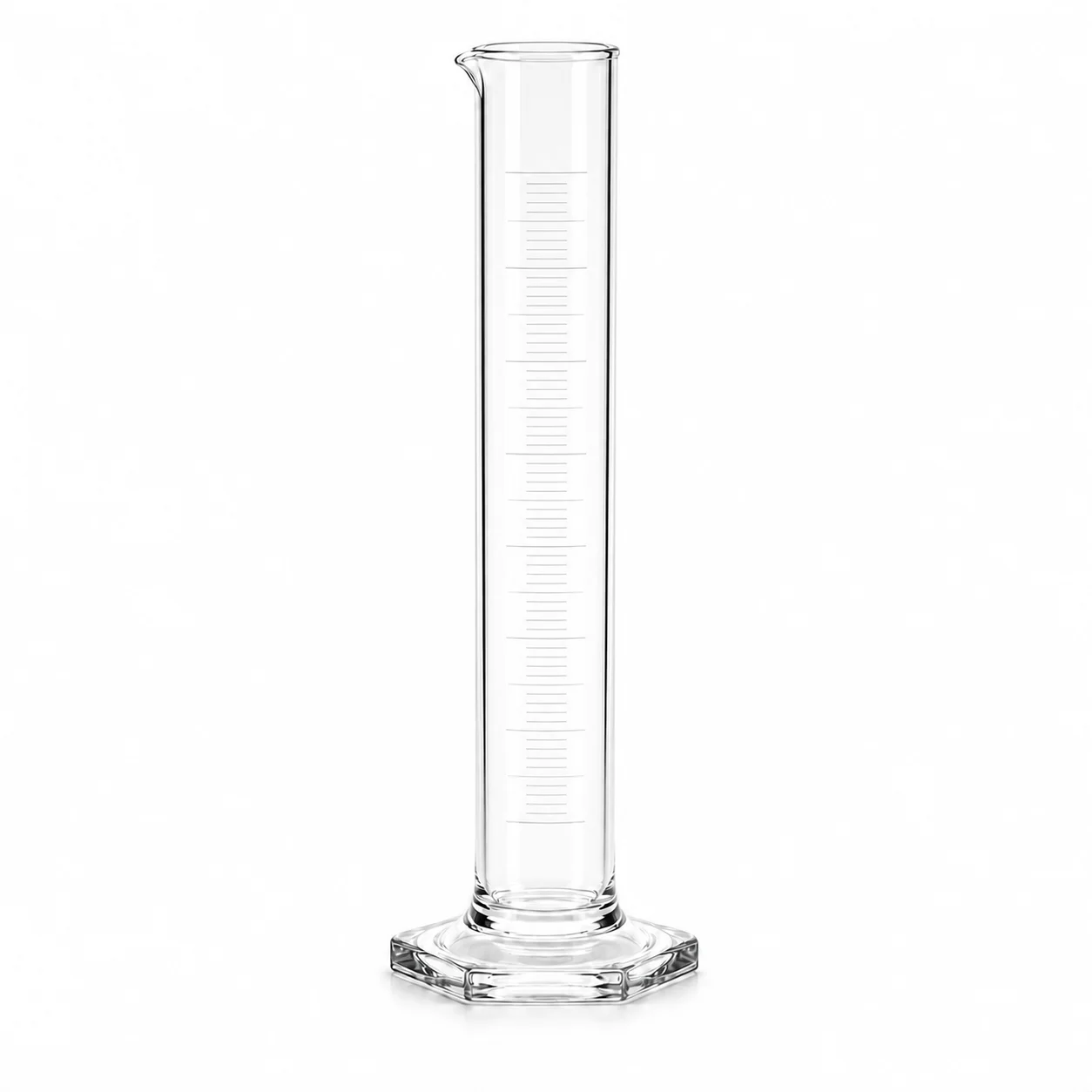
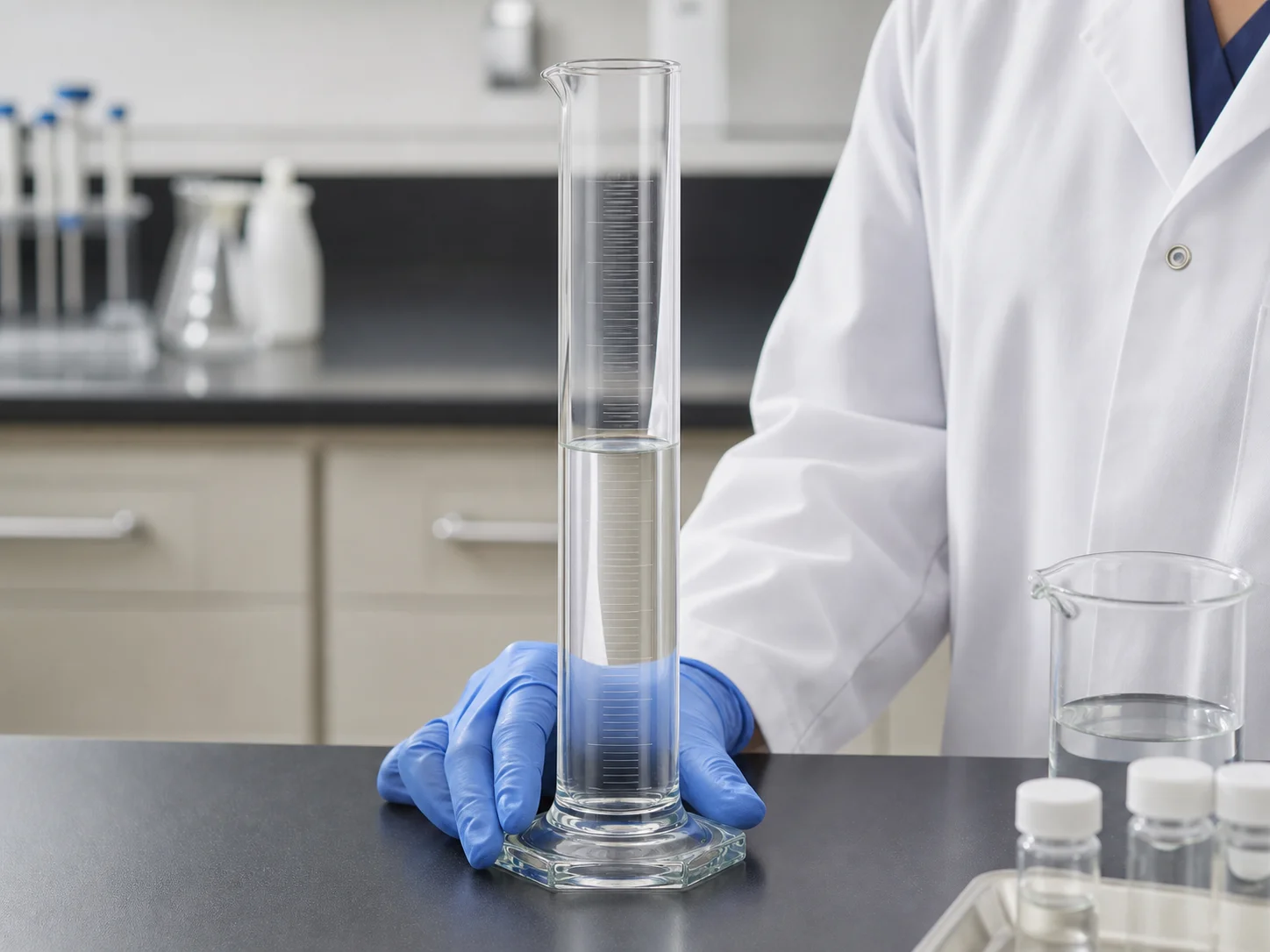
Tall graduated cylinder with fine scale divisions, a pouring lip and a hexagonal base
Shown configuration · cylinder alone / contents, capacity numerals and class marking not shown

Volumetric glassware

Graduated Cylinder

A graduated measuring cylinder to ISO 4788 in borosilicate 3.3, made in tall and squat forms with a hexagonal foot and a drawn pouring lip.

ISO 4788 types 1a, 1b and 2Hexagonal anti-roll baseCalibrated at 20 °C
Stock status
In stock
Lead time
2–3 weeks
FOB price / pc
$0.80 - $1.15
MOQ
3,000 pcs

Final availability, dimensions, materials, assembled components and commercial terms are confirmed against the selected drawing and approved sample.

Read fast, not finely

Bulk measurement, not analytical work

Hex foot earns its keep

A cylinder that rolls off a bench breaks

Tall or squat

Form changes both accuracy and stability

Graduated Cylinder profile

The most used piece of volumetric glass, and the least suited to analytical claims.

Forms, accuracy expectations & handling

What a cylinder is genuinely for, and what should go in a flask instead.

A measuring cylinder is a working tool: it measures a solvent for a rinse, a volume for a dilution that will later be made up properly, or a rough charge for a reaction. ISO 4788 covers its forms and limits. Understanding where it sits between a beaker's graduations and a volumetric flask's mark keeps it in the right job.

01

ISO 4788 describes three forms, not one

The standard covers tall form in two variants, 1a and 1b, and a squat form as type 2. Tall cylinders give a longer scale for the same volume, so each division occupies more height and reads more finely. Squat ones are far harder to knock over and suit a crowded bench. The choice is a real trade between readability and stability rather than a styling preference.

02

The cross-section sets the achievable accuracy

A cylinder of any given capacity has a wide bore compared with the neck of a volumetric flask, so the same misjudgment of the meniscus costs several times more volume. That is inherent geometry rather than manufacturing quality, and it is why no measuring cylinder, at any class, substitutes for a volumetric flask when a solution has to be made up to a stated concentration.

03

The hexagonal foot is a breakage control

A round-footed cylinder on a sloping or vibrating bench rolls, and a tall cylinder that starts rolling has already broken. The hexagonal or polygonal base stops that and gives a wider bearing surface, which also resists the tipping moment when a full 1000 mL cylinder is set down slightly off-center. It costs nothing and prevents a specific, common accident.

04

Read at eye level or accept a parallax error

Because the graduation lines run around a curved wall, a reading taken from above or below crosses the line at an angle and reports a level that is not there. On a wide cylinder, the parallax error easily exceeds the class tolerance. Cylinders are read with the scale at eye height on a level surface, not held up to a window.

05

Plastic and glass fail in opposite directions

Borosilicate withstands heat and virtually all solvents, and it breaks. Polypropylene cylinders survive being dropped and are cheaper, and they are attacked by some solvents and lose their marks. Laboratories running organic solvents keep glass; teaching laboratories and field work often move to plastic and accept the wider tolerance that usually comes with it.

06

Graduations are printed and printing can be lost

Scales are fired enamel on quality cylinders and printed ink on cheaper ones. Dishwashers, alkaline detergents and abrasive brushes take printed scales off within a term, leaving a cylinder that looks fine and reads nothing. Where cylinders are machine washed, fired-on marking is worth the difference, and it is easy to check on a sample before ordering.

Application guide

Accuracy comes from a narrow bore and a careful eye.

A graduated cylinder measures better than a beaker because a tall narrow column turns a small volume difference into a large height difference, and worse than a volumetric flask because it measures many volumes rather than one. These are development directions confirmed against the method.

Graduated Cylinder used for volumes measured on a bench in a routine measurement setting

Routine measurement

Volumes measured on a bench

For measuring out solvents, buffers and reagents where reasonable accuracy is needed but a volumetric flask would be impractical for a variable amount. The narrow bore spreads the scale, and the operator reads the bottom of the meniscus at eye level to get the stated volume.

  • Read the meniscus at eye level
  • Match the capacity to the volume needed
  • Confirm the scale suits the range
Graduated Cylinder used for two cylinders that look identical in a purchasing decisions setting

Purchasing decisions

Two cylinders that look identical

For the person ordering glassware from a catalog where one cylinder costs half what the other does and both read the same at a glance. They are made to different tolerance classes, and a method written around the tighter one will keep producing numbers that look precise, so the class comes from the method.

  • Establish the class the method needs
  • Confirm the class of what is supplied
  • Retain calibration documentation
Graduated Cylinder used for a tall vessel that must not tip in a stability setting

Stability

A tall vessel that must not tip

A tall narrow cylinder is inherently unstable on a crowded bench, which is why the base is made wide and often polygonal so it will not roll away if it is knocked over. Base design matters practically here, since a toppled cylinder loses the measurement, the reagent and frequently the cylinder itself.

  • Confirm the base resists tipping
  • Check it will not roll if knocked
  • Use on a clear bench area

Applications describe development directions. Accuracy, calibration class and laboratory outcomes are confirmed for the selected program.

Common questions

Graduated Cylinder questions

Cylinders get used for work they were never intended to do. These questions draw the line.

Can we make up a standard solution in a measuring cylinder?

Not if the concentration is being reported. A cylinder has a wide bore compared with the neck of a volumetric flask, so the same misreading of the meniscus costs several times more volume. That is geometry, not build quality, and no accuracy class fixes it. Use the cylinder for the bulk solvent and finish in a volumetric flask at the mark.

Our scales are fading in the washer. What went wrong?

Printed graduations rather than fired ones. Alkaline detergents, machine washing and abrasive brushes remove printed ink within a term, leaving a cylinder that looks perfectly serviceable and reads nothing reliable. Where cylinders go through a washer, fired enamel marking is worth the difference. It is easy to verify on a sample before committing to an order.

Glass or polypropylene?

They fail in opposite directions. Borosilicate takes heat and almost any solvent, and it breaks when dropped. Polypropylene survives the drop and costs less, but some solvents attack it and its marks wear. Laboratories running organic solvents keep glass; teaching and field work often take plastic and accept the wider tolerance that usually accompanies it.

How should the level be read?

At eye level, or accept a parallax error. Reading a meniscus from above or below shifts the apparent level by more than the cylinder's tolerance, which quietly undoes the accuracy the form was chosen for. Bring the eye to the mark rather than the cylinder to the eye.

Next step

Send us the Graduated Cylinder brief.

Tell us the product, fill volume, closure preference and destination market. We will come back with the matching drawings, available configurations and a sample plan before anything is quoted.

  • 01Send the briefProduct, volume, closure and market
  • 02Get the optionsMatching drawings and configurations
  • 03Approve the sampleConfirm the pack before production