Metering, priming & preservative strategy
Six things that determine what the patient actually receives.
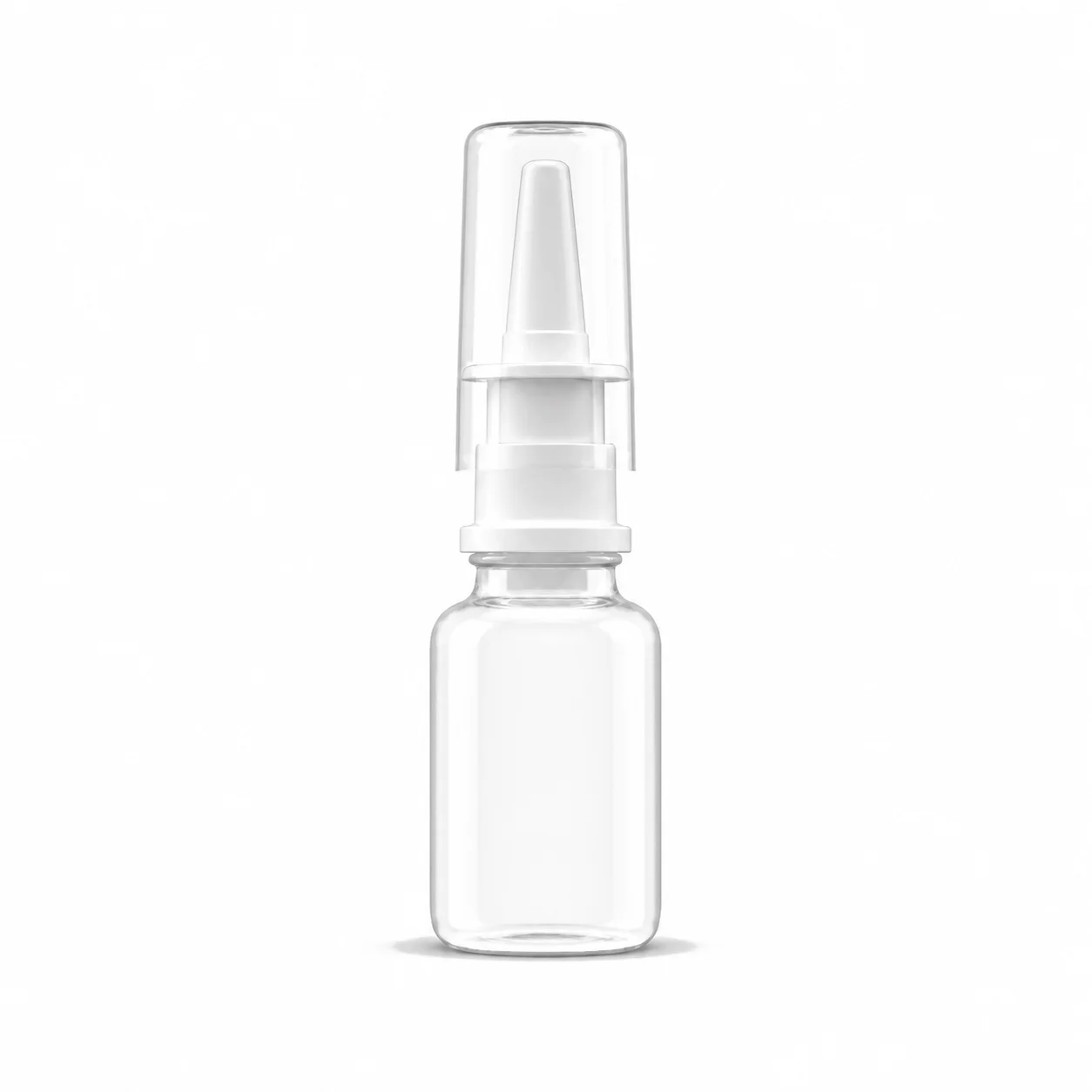
A nasal spray delivers a fixed volume as a plume of droplets into a nasal cavity. The metering chamber in the pump sets the volume, the nozzle sets the spray geometry, and the bottle supplies the neck the pump clamps onto and the base the dip tube has to reach. All three have to be specified together.
Metering is a chamber, not a squeeze
Each actuation fills a small chamber and expels its contents, so the delivered volume is fixed at around 0.05 to 0.1 mL depending on the pump, typically held within about ten percent. That independence from how hard the patient presses is the whole reason a metered pump is specified rather than a squeeze bottle, which delivers whatever the hand decides.
Priming and re-priming are real losses
A new pump has air in the chamber and needs several actuations to deliver a full dose, and one left unused for days may need re-priming. Those actuations come out of the fill, so overfill is calculated to cover priming plus the labeled number of doses. A pack that ignores this runs out before the last labeled dose.
The nozzle sets the plume, and the plume matters clinically
Spray angle, droplet size distribution and plume geometry decide where in the nasal cavity the dose deposits. A finer plume carries further; a coarser one deposits anteriorly. These are measured properties of the pump and nozzle with a given formulation viscosity, which is why a formulation change can invalidate spray characterization even with identical hardware.
Preservative-free means a different pump architecture
A conventional pump draws air back into the bottle as it empties, which is why multi-dose nasal sprays are usually preserved. Preservative-free systems use a filter, a collapsing bag or a one-way valve to prevent that ingress. They cost more and change the bottle, and the decision is made with the formulation rather than added afterwards.
The dip tube has to reach a base it fits
The tube is cut to the internal height of that particular bottle, and a bottle with a punt or an uneven base leaves the last doses unreachable. On a small nasal pack that can be several labeled doses out of a month's supply, which is a patient-visible failure rather than a rounding error. Bottle and tube are dimensioned together.
Actuation force and stroke are part of the clinical evidence
The spray pattern that a nasal product is approved on is produced by a specific pump at a specific stroke, so a change in pump supplier or in actuator geometry is a change to the delivered product. That is why these components are locked in the specification and revalidated rather than substituted on price.