Chemical attack, closure selection & storage practice
Where the risks actually sit in a corrosives cupboard.
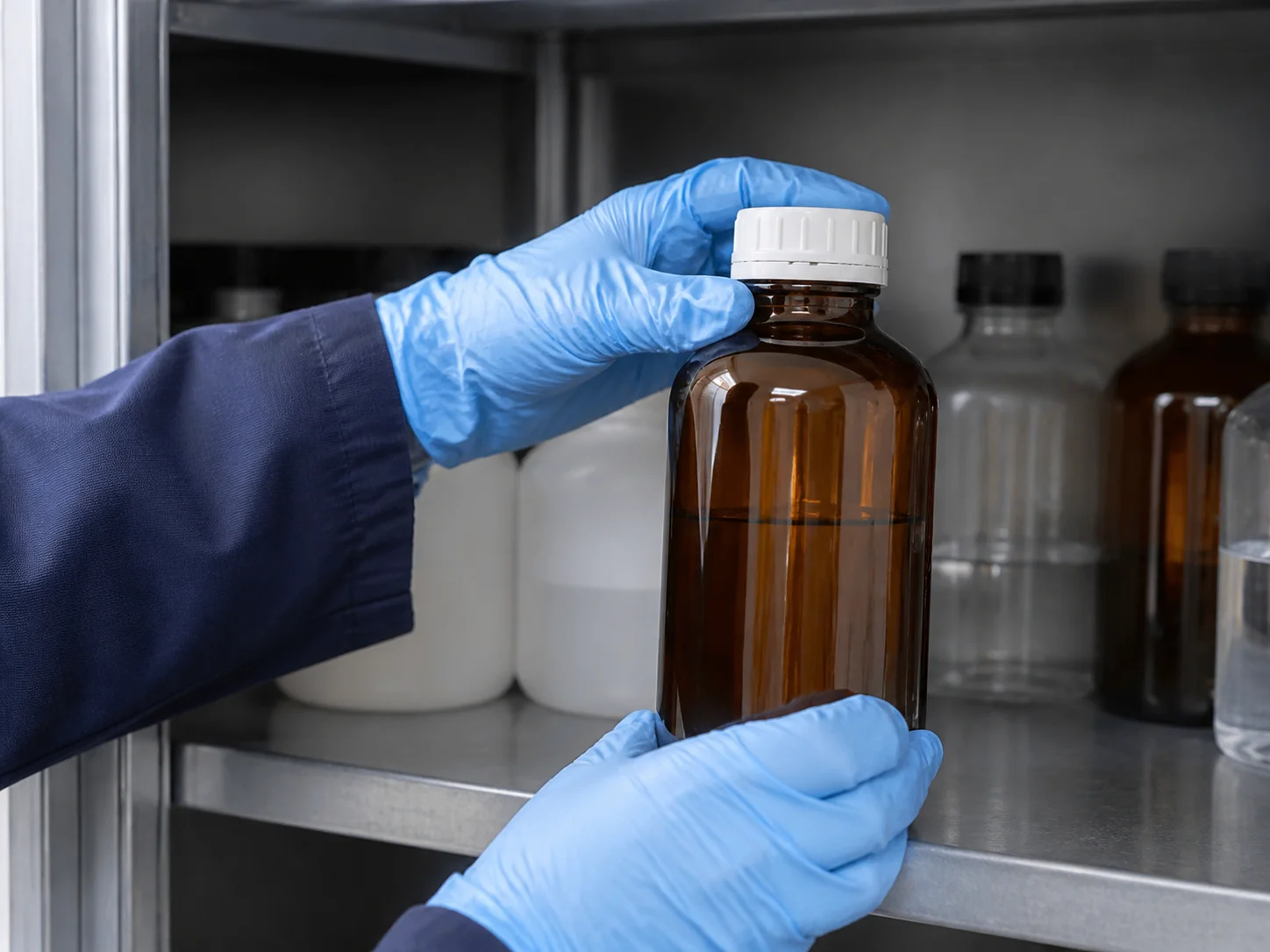
For corrosive storage the glass is rarely the weak point: borosilicate resists nearly every common acid, and soda-lime handles most dilute ones. What fails is the liner, the cap, the label and the shelf. Specifying a corrosive pack means specifying those four things at least as carefully as the bottle.
Two chemistries attack glass, and both are specific
Hydrofluoric acid dissolves silica outright and is not stored in glass at all. Hot concentrated alkali etches it slowly, which shows up first as faded graduations, roughened sealing surfaces and ground stoppers that seize. Everything else — nitric, sulfuric, hydrochloric, phosphoric, organics — is comfortably held. The exceptions are worth knowing precisely because they are so narrow.
Hydrolytic class describes how much the glass gives up
ISO 719 classifies glasses by resistance at 98 °C and ISO 720 at 121 °C, with borosilicate at the resistant end and soda-lime well below it. For a stored acid the leaching of alkali from the glass is usually irrelevant; for a trace-metal standard or a long-stored dilute solution, it is the whole question. The class belongs on the specification for those cases.
The liner is the component under attack
A general-purpose foam or pulp liner will not survive concentrated acid vapor for long, and its failure is a leak and a contamination at once. PTFE-faced liners are the default for corrosives because only fluoropolymer meets the vapor. It is a small line item that determines whether a bottle is still sealed after a year on a shelf.
Volatile acids need a vent, not a tighter cap
Concentrated hydrochloric acid builds pressure in a warm cupboard and pushes vapor past any closure, corroding shelving and neighbors. The answer is a vented closure designed to release pressure while retaining liquid, plus storage that assumes some vapor escapes. Tightening a plain cap harder makes the failure less frequent and more dramatic when it comes.
Segregation is part of the container decision
Acids and bases stored together will eventually meet through a spill or a broken bottle, and oxidizing acids stored with organics are a fire scenario rather than a cleanup. Bottle size influences all of this: several small bottles in separate trays are safer than one large one, even though the larger bottle is cheaper per liter.
Labels have to outlive the contents
A label that has been splashed, faded or eaten away leaves an unidentified corrosive, which is a disposal problem far more expensive than the reagent. Chemical-resistant label stock, a protective overlaminate and a date written on receipt are cheap. They matter most for the bottle at the back of the cupboard that nobody has touched for three years.