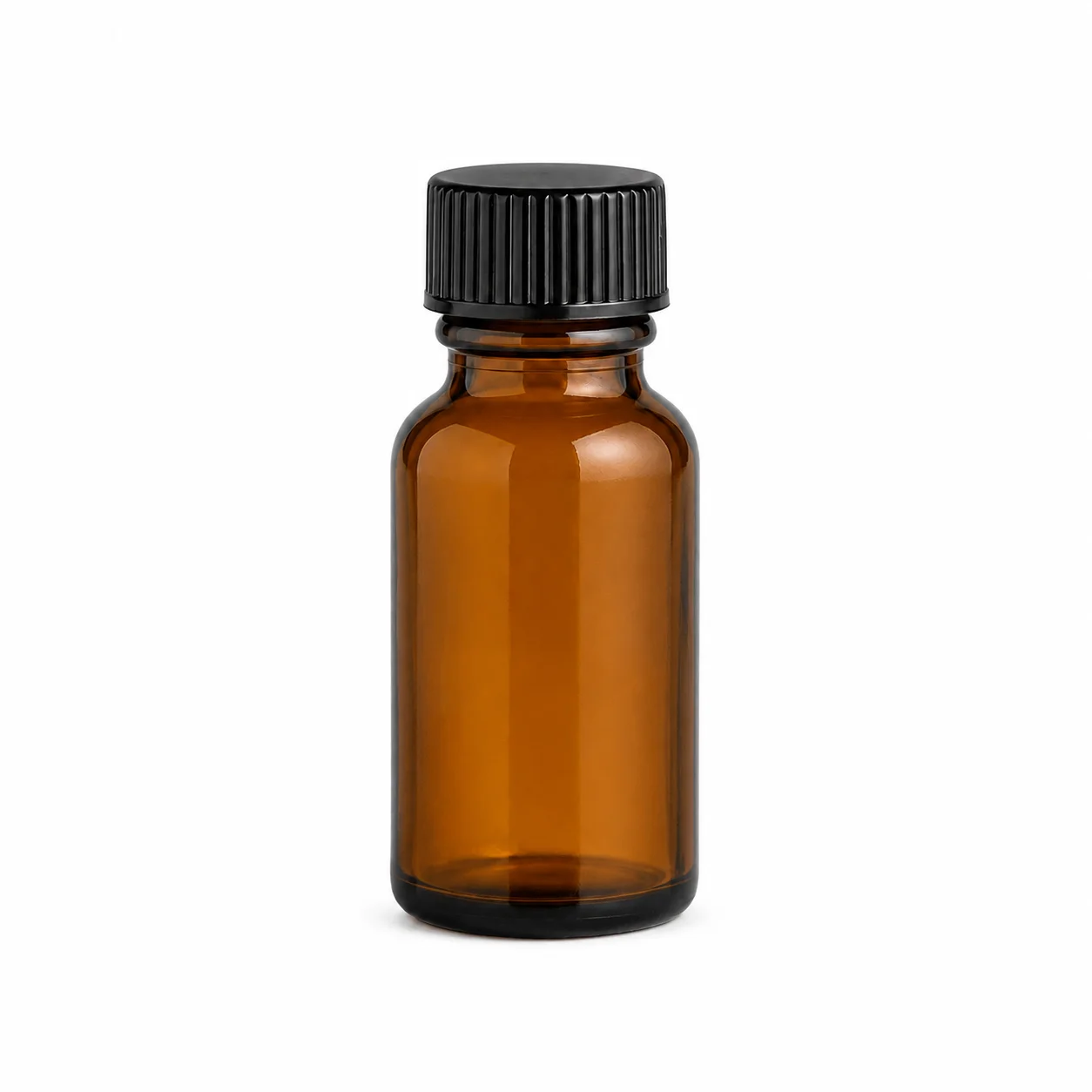
Amber round-shouldered bottle with a black ribbed screw cap
Shown configuration · bottle with cap / oil, liner, label and dropper insert not shown

Flavor & fragrance materials

Flavor & Fragrance Bottle

A bottle for essential oils, aroma chemicals and compounded flavors, where the closure liner has to stop terpenes escaping and stop the cap contaminating the oil.

PTFE-faced or cone linersAmber against lightHeadspace controlled
Stock status
In stock
Lead time
2–3 weeks
FOB price / pc
$0.30 - $0.60
MOQ
3,000 pcs

Final availability, dimensions, materials, assembled components and commercial terms are confirmed against the selected drawing and approved sample.

Terpenes attack liners

Foam and pulp discs fail against citrus oils

Oxygen ages the top notes

Small bottles beat one large one

Amber for the working shelf

Compounding benches are brightly lit

Flavor & Fragrance Bottle profile

The material is worth more per liter than the pack by orders of magnitude, and the pack is what loses it.

Liner chemistry, oxidation & handling small volumes

Five ways an expensive oil is degraded by an inexpensive component.

Essential oils and aroma chemicals lose value through three routes: evaporation of the volatile fraction, oxidation of the top notes, and contamination from whatever the liquid touches. A bottle for these materials is specified almost entirely to close those three routes, which is why the liner receives more attention than the glass.

01

Terpenes go through ordinary liners

Citrus and conifer oils are rich in terpenes that swell and eventually dissolve foam and pulp liners, at which point the cap leaks and the oil carries liner extractables. PTFE-faced liners and conical polyethylene inserts that seal in the bore are the two standard answers. It is the single most consequential line on a flavor and fragrance packaging order.

02

Oxidation is driven by headspace, not by time alone

A half-empty bottle holds a volume of air against a material whose top notes oxidize readily, and the damage accumulates every time it is opened. Buying and decanting into smaller bottles as a stock is used, rather than working from one large bottle to the bottom, preserves far more value than any change to the closure specification.

03

Amber is worth more here than in a cupboard

Compounding benches are brightly lit, and bottles sit out during a working session rather than living in the dark. For photosensitive materials, that exposure is the real one. Amber glass absorbs the short wavelengths that drive the reactions, and the visibility it costs is easier to accept on a bottle whose level is checked by weight anyway.

04

Dropper inserts trade access for exposure

An orifice reducer or a dropper insert makes it possible to take drops from an expensive oil without decanting, which reduces waste and handling. It also leaves a path to the atmosphere that a plain lined closure does not. On materials that are used weekly, that is a good trade; on a stock bottle opened twice a year it is not.

05

The label has to survive the material

Oils creep, and an oil that runs down the outside of a bottle takes ink and adhesive with it. Chemical-resistant label stock and a laminate cost little against materials priced by the gram, and an unidentified bottle of an expensive aroma chemical usually ends up being discarded rather than analyzed. It is worth specifying with the pack.

06

Most of these concentrates are flammable liquids

Alcohol carriers and many essential oils fall into flammable transport classes, which brings quantity limits, marking and packaging approval into what looks like an ordinary bottle order. Establishing the classification of the actual material before specifying the pack avoids discovering it at the freight forwarder.

Application guide

The whole product is a smell, so nothing may taint it.

Flavor and fragrance concentrates are evaluated by nose and palate, which means any odor picked up from a cap liner or any component leached into the liquid destroys the sample entirely. These are development directions confirmed by sensory evaluation.

Flavor & Fragrance Bottle used for concentrates sent to customers for evaluation in a sample supply setting

Sample supply

Concentrates sent to customers for evaluation

For samples shipped to a brand or a flavorist who will assess them against competing submissions. The pack has to arrive with the sample smelling exactly as it left, since a faint plastic note from a liner is enough to lose the business regardless of how good the formulation is.

  • Confirm the liner is odor-neutral
  • Run a sensory check after shipping
  • Protect against heat in transit
Flavor & Fragrance Bottle used for top notes that escape a poor seal in a volatility setting

Volatility

Top notes that escape a poor seal

The lightest and most characteristic components of a fragrance are also the first to escape through a marginal closure, which gradually shifts the profile toward the heavier base notes over a few weeks of storage. Seal quality therefore directly changes what the customer smells when the sample is finally opened and assessed.

  • Confirm the closure holds top notes
  • Assess the profile after storage
  • Limit headspace where possible
Flavor & Fragrance Bottle used for bottles kept open on a lit bench in a perfumers' organs setting

Perfumers' organs

Bottles kept open on a lit bench

For the racks a perfumer or flavorist works from, where the same materials sit under bench lights for years and are judged by nose every time. Many aroma compounds oxidize or darken in that light, which is why the category settled on amber, and the real answer comes from smelling held samples rather than from the glass.

  • Store samples under realistic light
  • Evaluate the profile over time
  • Confirm the tint suits the compounds

Applications describe packaging directions. Formula compatibility, sensory integrity and regulatory outcomes are confirmed for the selected program.

Common questions

Flavor & Fragrance Bottle questions

The material costs far more than the pack, and the pack is where it is lost.

Why do our caps leak with citrus oils?

Terpenes. Citrus and conifer oils swell and eventually dissolve foam and pulp liners, after which the cap leaks and the oil carries liner extractables. PTFE-faced discs or conical polyethylene inserts that seal in the bore are the standard answers, and the choice between them is the most consequential single line on a flavor and fragrance order.

How do we stop top notes fading in storage?

Reduce headspace and reduce openings. A half-empty bottle holds air against a material whose top notes oxidize readily, and the damage compounds with every opening. Decanting into smaller bottles as stock is used preserves far more value than any change of closure, and it costs a few bottles rather than a specification change.

Is amber necessary if we keep bottles in a cupboard?

Less necessary, but compounding benches are brightly lit and bottles sit out during a working session, which is the exposure that matters. Amber absorbs the short wavelengths that drive photo-oxidation. The visibility it costs is easy to accept on a bottle whose level is tracked by weight rather than by looking at it.

Should we fit dropper inserts?

On materials used weekly, yes: taking drops without decanting reduces waste and handling. On a stock bottle opened twice a year, no, because an insert leaves a path to the atmosphere that a plain lined closure does not. Decide per material and per usage rate rather than fitting them across a whole range.

Are these concentrates flammable?

Most of them are, and that changes the packaging brief. Flammable liquid classification affects the closure, the labeling and how the pack may be shipped, so it belongs in the specification from the start rather than being handled at dispatch.

Next step

Send us the Flavor & Fragrance Bottle brief.

Tell us the product, fill volume, closure preference and destination market. We will come back with the matching drawings, available configurations and a sample plan before anything is quoted.

  • 01Send the briefProduct, volume, closure and market
  • 02Get the optionsMatching drawings and configurations
  • 03Approve the sampleConfirm the pack before production