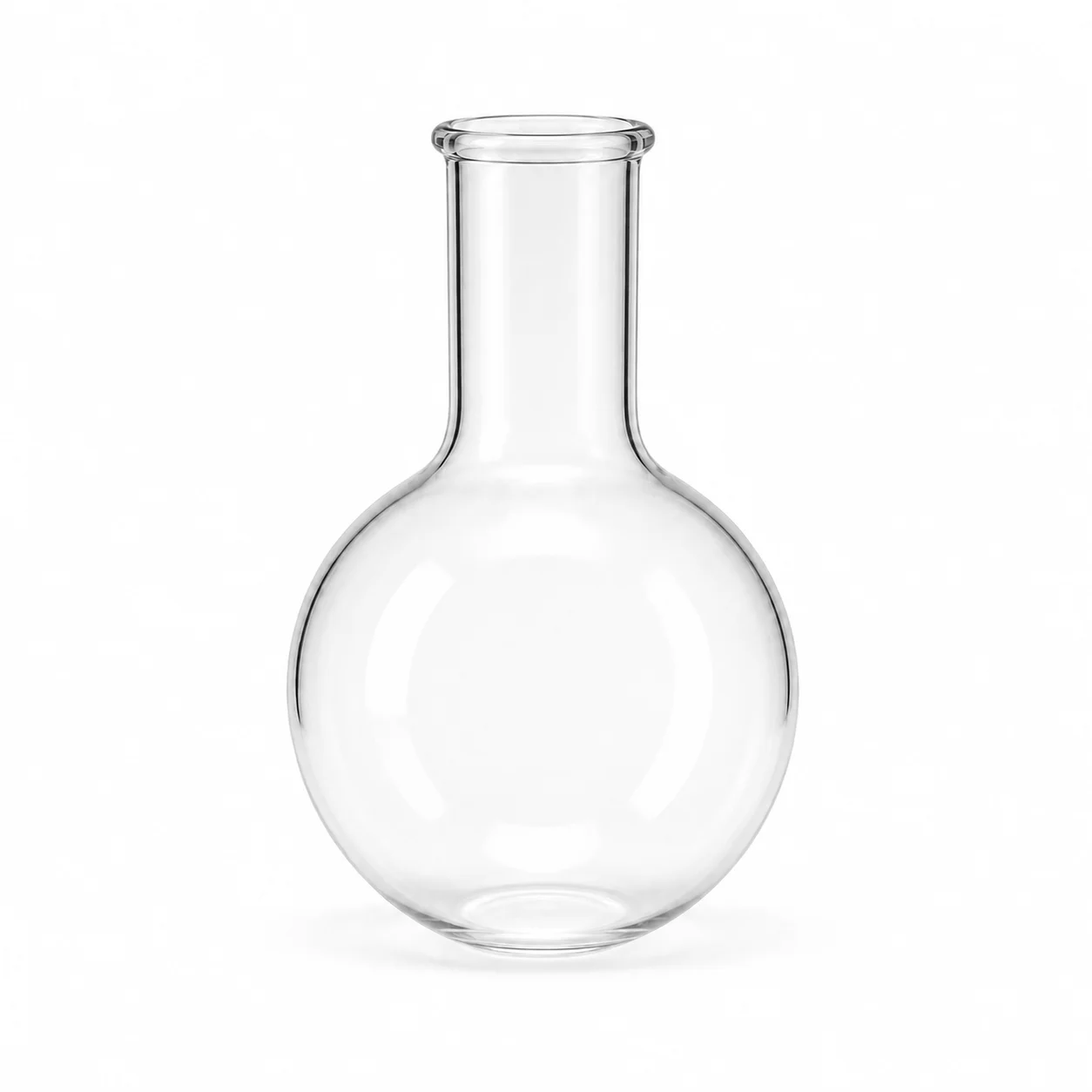
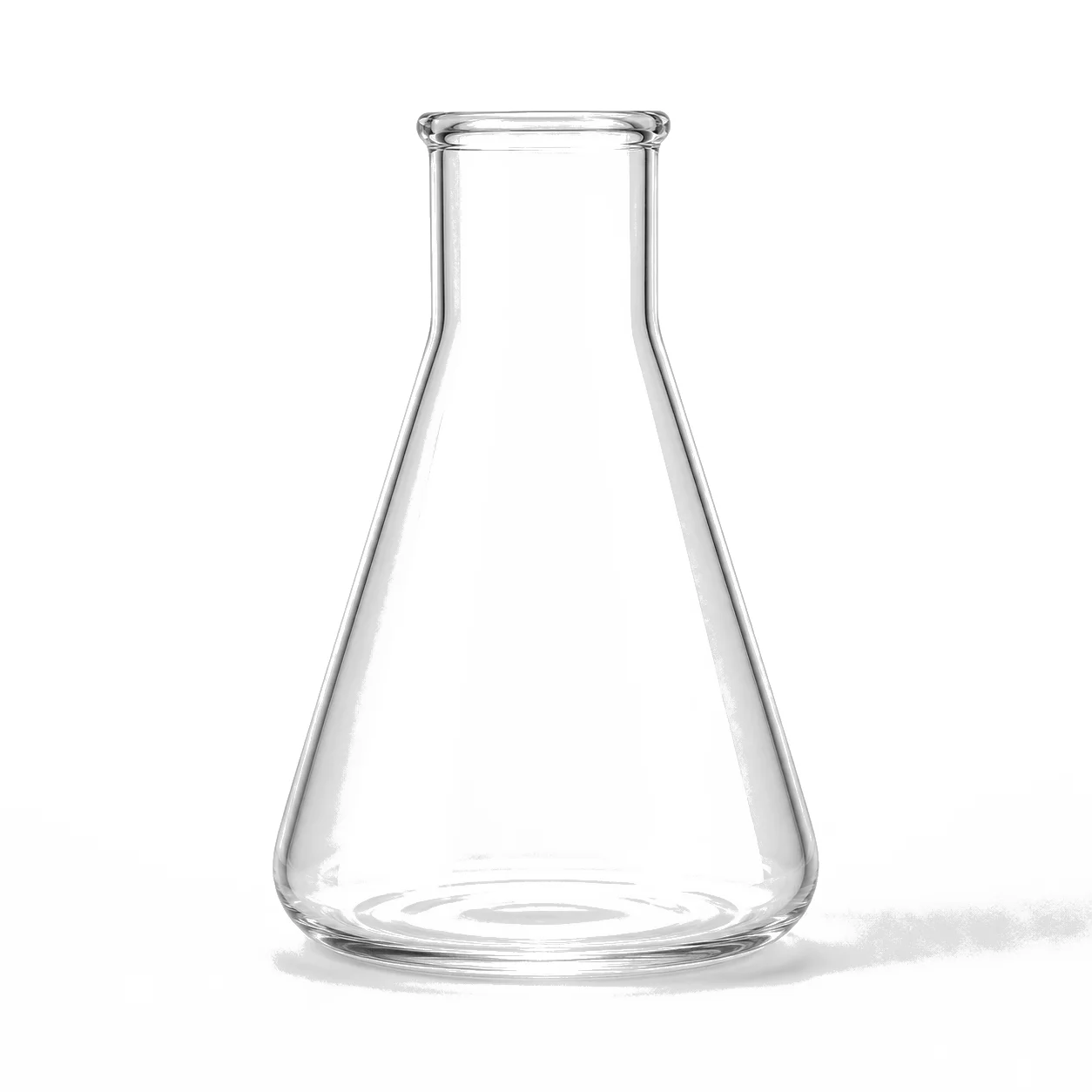
Conical Erlenmeyer flask with a flat base, sloping wall and short open neck
Shown configuration · open flask / stopper, contents and printed scale not shown

General laboratory glassware

Erlenmeyer Flask

A conical flask in borosilicate 3.3, supplied narrow-necked to ISO 1773 or wide-necked to ISO 24450, with the sloping wall that lets a solution be swirled hard without loss.

ISO 1773 and ISO 24450Narrow or wide neckSwirls without spilling
Stock status
In stock
Lead time
2–3 weeks
FOB price / pc
$0.60 - $1.00
MOQ
3,000 pcs

Final availability, dimensions, materials, assembled components and commercial terms are confirmed against the selected drawing and approved sample.

Geometry does the work

Cone returns liquid to the base when swirled

Neck sets the job

Narrow for storage, wide for solids

Stoppered or plugged

Ground-neck versions take ISO 383 joints

Erlenmeyer Flask profile

The shape solves one problem completely: how to mix vigorously without losing anything.

Neck width, standards & what the cone buys you

The decisions behind a flask that looks like it has none.

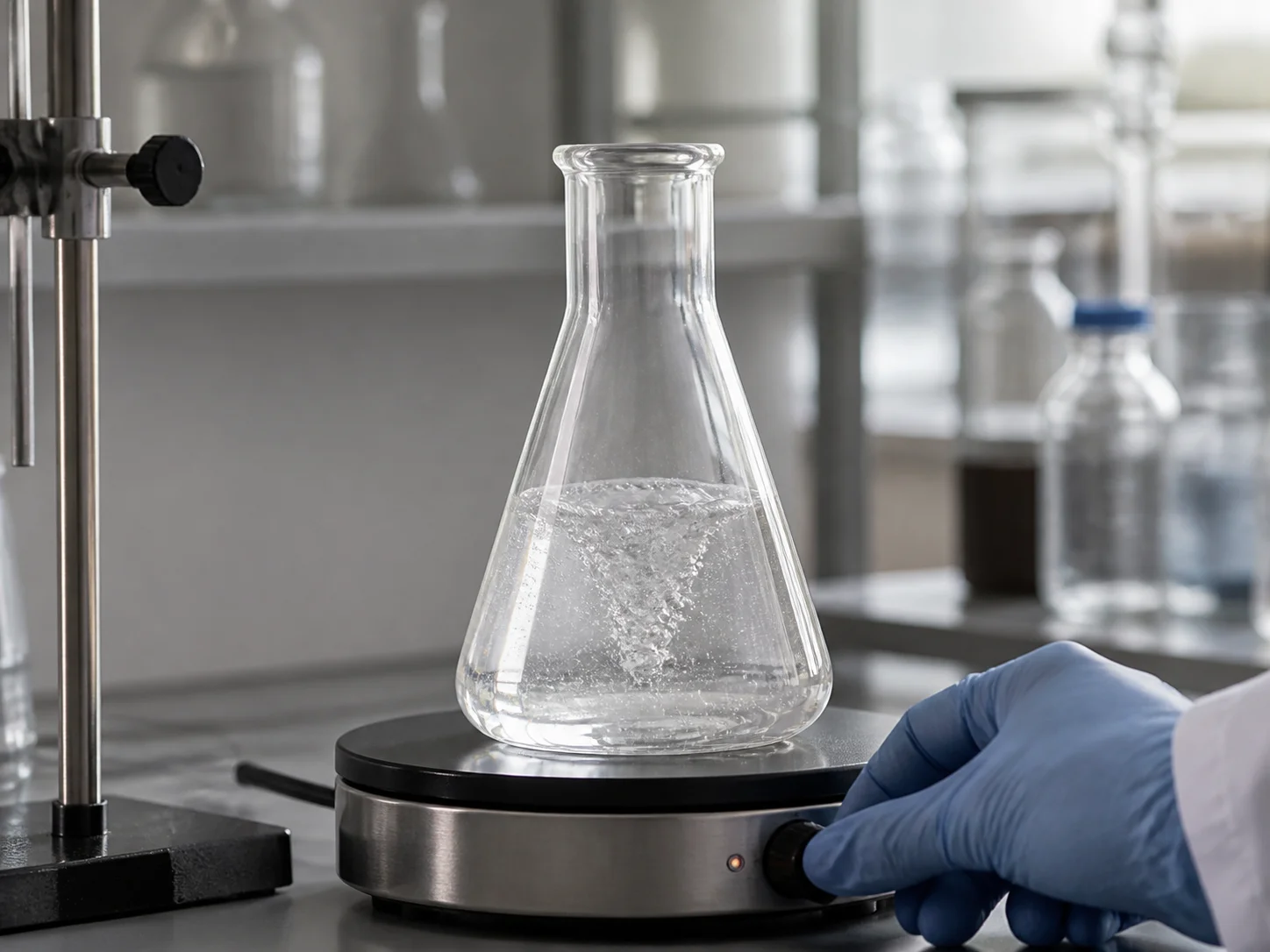
A conical flask can be swirled hard, one-handed, while a titrant runs into it, and the sloping wall throws the liquid back toward the base instead of over the rim. That single property is why it is the standard receiving vessel for titration, and why cultures, digestions and any procedure needing constant agitation end up in one.

01

Two standards, split by neck

Narrow-necked conical flasks fall under ISO 1773 and wide-necked ones under ISO 24450. It is not a trivial split: a narrow neck restricts evaporation, takes a stopper cleanly and keeps splashes in, while a wide neck admits a spatula, a solid charge or a filter funnel. Laboratories usually need both, and ordering by capacity alone will get whichever the supplier stocks.

02

The cone is what makes hard swirling possible

In a straight-sided vessel, swirling drives liquid up the wall and out. The sloping wall of a cone converts that outward motion into a return toward the center, so an analyst can agitate a titration continuously with one hand and watch the endpoint with the other. No other common vessel geometry allows that, which is why the shape has outlived several attempts to replace it.

03

Ground necks turn a flask into apparatus

Versions with an ISO 383 conical joint accept condensers, stoppers and adapters, which moves the flask from a receiving vessel into a piece of assembled apparatus for reflux, digestion or distillation. The joint has to be specified with the flask, since a laboratory that standardizes on 24/29 and then buys 29/32 flasks acquires a shelf of glassware that fits nothing it owns.

04

Culture work uses the same shape for a different reason

In shaken culture the cone maximizes the liquid surface for a given volume while keeping the medium contained during orbital shaking, which is how oxygen transfer is achieved without a sparger. Baffled variants push that further by breaking the rotating vortex. It is the same geometry serving gas exchange rather than mixing, and it changes what fill volume is sensible.

05

Graduations here are working marks

As with beakers, the scale on a conical flask is a guide rather than a calibration, and the tapering wall makes it less linear than a cylinder's. That is rarely a problem, because the flask is normally the receiving vessel in a titration where the volume delivered from the burette is the measured quantity and what sits in the flask does not need to be known precisely.

06

Flat base, thin wall, and a limit on vacuum

A conical flask stands unaided and heats well on a plate, but its flat base is the wrong shape to resist external pressure. Standard conical flasks are not vacuum vessels; that duty belongs to a heavy-walled filter flask designed for it. Using one under vacuum is a specific, well-known way to implode glassware across a bench.

Application guide

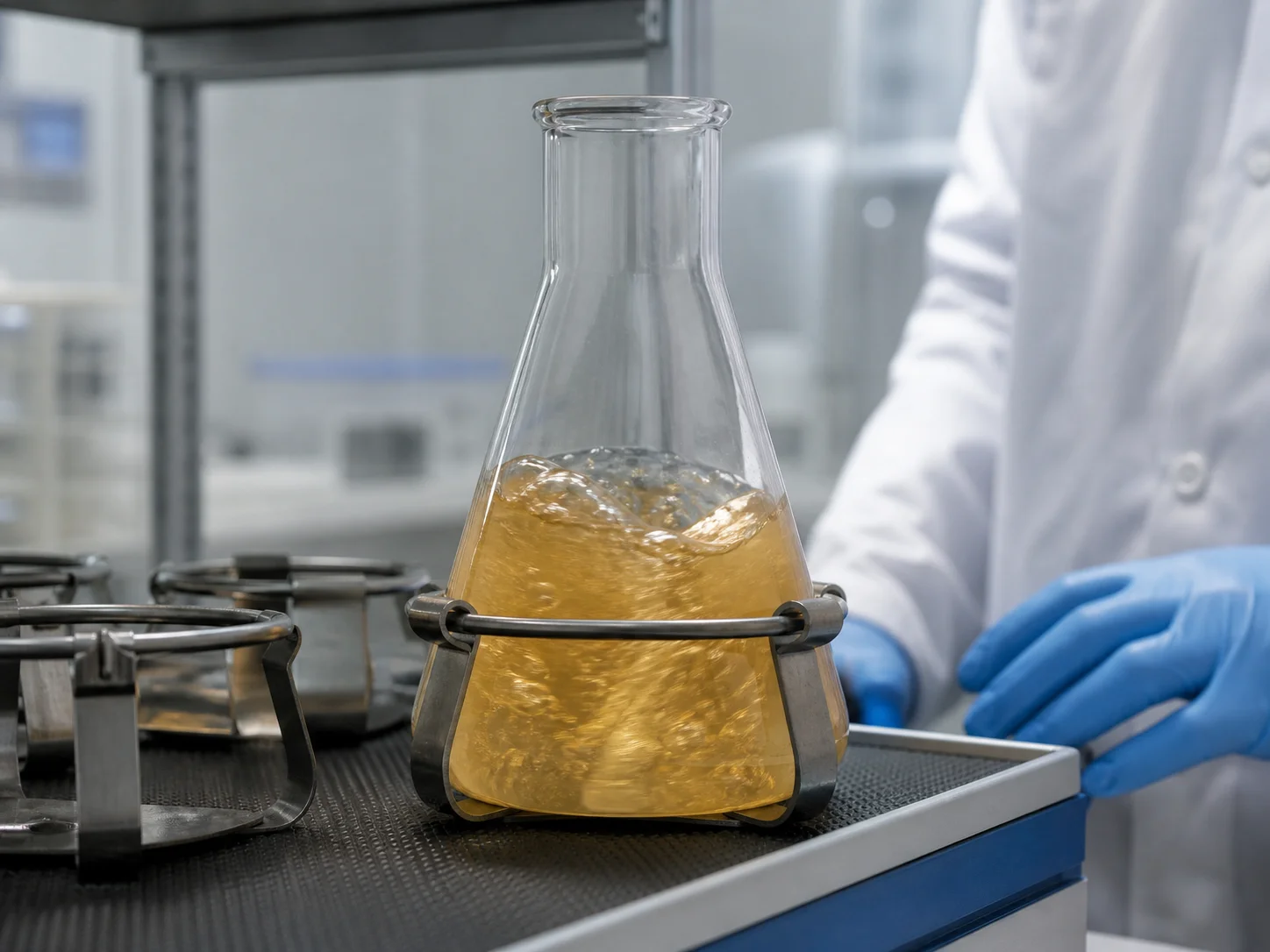
The cone lets you swirl without spilling.

The conical body is what makes this flask useful: liquid can be swirled vigorously because the narrowing neck keeps it contained, and the wide base keeps the vessel stable while it happens. These are development directions confirmed with the actual method.

Erlenmeyer Flask used for flasks swirled continuously during a procedure in a titration setting

Titration

Flasks swirled continuously during a procedure

For a technician swirling a solution with one hand while running reagent in from a burette with the other, watching for a color change. The taper contains liquid through that constant motion, which a beaker of the same volume simply cannot do without splashing over the bench.

  • Confirm swirling stays contained
  • Check the base stays stable when swirled
  • Match the volume to the titration
Erlenmeyer Flask used for flasks shaken on a platform in a culture and incubation setting

Culture and incubation

Flasks shaken on a platform

In microbiology the same shape is shaken for hours on an orbital platform, where the cone generates the turbulence that keeps a culture aerated. Neck size, baffling and how the flask clamps to the platform all follow from that use rather than from bench work.

  • Confirm the neck suits the closure used
  • Check the flask clamps securely
  • Review aeration for the culture
Erlenmeyer Flask used for direct heat under a broad base in a heating setting

Heating

Direct heat under a broad base

The flat base sits on a hotplate or in a mantle, and the wide bottom spreads heat while the narrow neck limits evaporation. Whether the glass tolerates that gradient repeatedly depends on the grade and on how quickly it is cooled afterward.

  • Confirm the glass suits direct heating
  • Avoid rapid cooling after use
  • Inspect the base for stress marks

Applications describe development directions. Method suitability, thermal performance and laboratory outcomes are confirmed for the selected program.

Common questions

Erlenmeyer Flask questions

Neck width, joints and vacuum are where conical flask orders go wrong.

Why is a conical flask better than a beaker for titration?

Because it can be swirled hard without losing anything. In a straight-sided vessel, swirling drives liquid up the wall and over the rim; the sloping wall of a cone turns that motion back toward the center. That lets an analyst agitate continuously with one hand while running titrant with the other, which is exactly what an endpoint determination requires.

Can we pull a vacuum on one?

No. The flat base of a conical flask is the wrong geometry to resist external pressure and standard wall thicknesses are not intended for it. Vacuum filtration uses a heavy-walled filter flask built for the duty. Applying vacuum to an ordinary conical flask is a well-documented way to distribute glass across a bench and the people at it.

Do we need baffled flasks for cell culture?

Only if oxygen transfer is limiting. Baffles break the rotating vortex on an orbital shaker and increase gas exchange considerably, at the cost of harder cleaning and more foaming with some media. Plain conical flasks are still the default for many cultures. Decide from the oxygen demand of the organism rather than adopting baffles as a general upgrade.

Why is the wall thin on a conical flask?

Because it is built for swirling and heating, not for vacuum. The flat base and thin section suit a bench vessel that is picked up and moved, but they are the reason it must never be evacuated. Use a heavy-wall filtering flask where suction is involved.

Next step

Send us the Erlenmeyer Flask brief.

Tell us the product, fill volume, closure preference and destination market. We will come back with the matching drawings, available configurations and a sample plan before anything is quoted.

  • 01Send the briefProduct, volume, closure and market
  • 02Get the optionsMatching drawings and configurations
  • 03Approve the sampleConfirm the pack before production