Tolerance class, TC calibration & thermal effects
Six things that decide whether the number on the neck means anything.
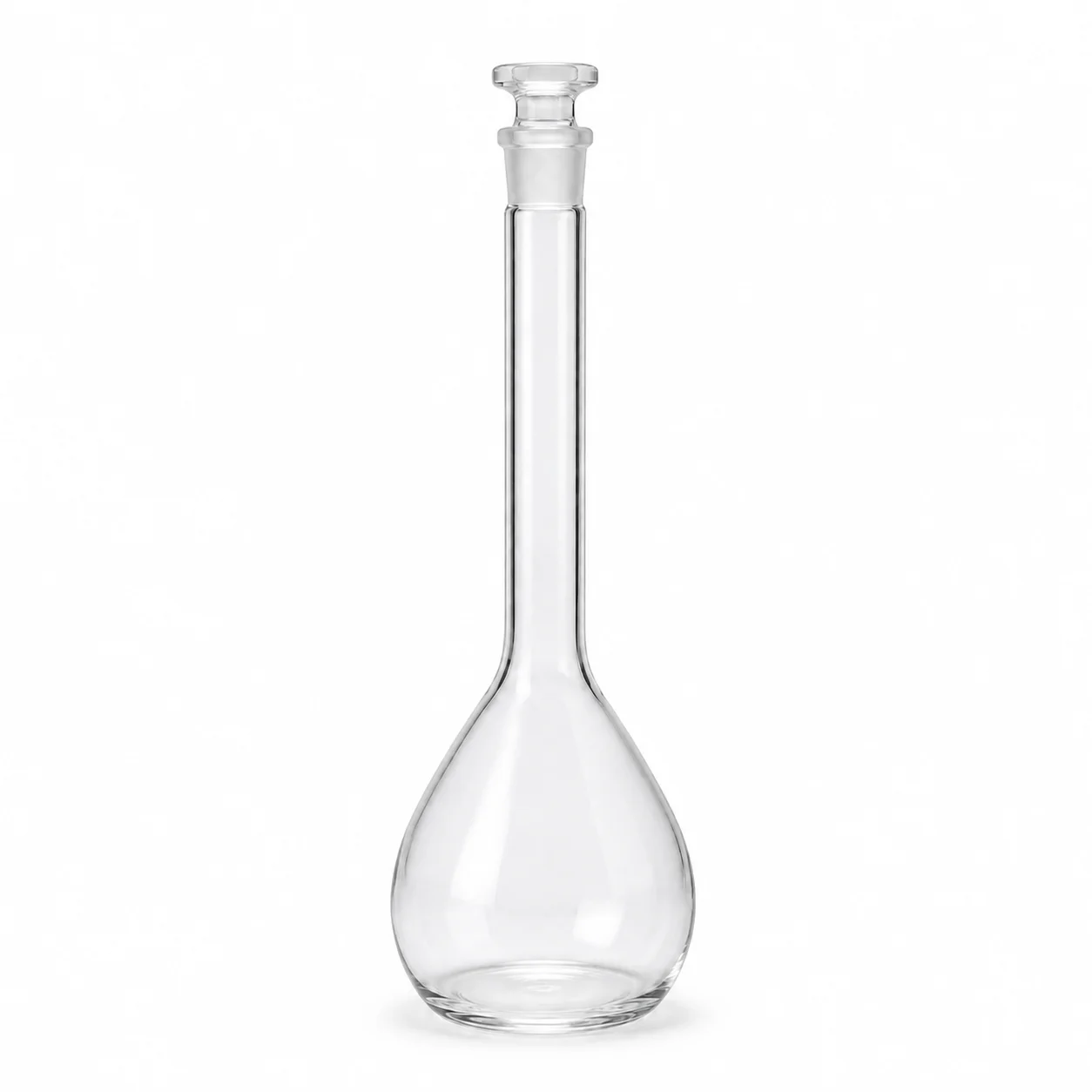
A volumetric flask is built to hold exactly one volume. The bulb gives capacity, the long narrow neck makes the meniscus sensitive enough to set precisely by eye, and the single ring is calibrated to contain that volume at 20 °C. Tolerance class, glass type and how the flask is handled after filling all follow from those three facts.
Class A and Class B differ by a factor of two
Under ISO 1042, a Class A flask holds ±0.10 mL at 100 mL, ±0.15 mL at 250 mL, ±0.25 mL at 500 mL and ±0.40 mL at 1000 mL. Class B tolerances are twice those values. The difference is not only glassmaking: Class A vessels are available with batch or individual certificates, while Class B is normally supplied without one.
The narrow neck is a measuring instrument
A given error in reading the meniscus translates into volume through the cross-section of the neck. Narrowing the neck means the same visual misjudgment costs less volume, which is why the neck of a 1000 mL flask is barely wider than that of a 100 mL. It also means neck damage or a scratched mark ruins the accuracy of the whole vessel.
TC means the residue belongs to the volume
Volumetric flasks are calibrated to contain rather than to deliver, so the stated volume is what sits in the flask at the mark, not what pours out. Emptying one and expecting the labeled volume leaves the film that clings to the wall behind. Where the contents must be transferred quantitatively, the flask is rinsed into the receiving vessel and the rinsings included.
Twenty degrees is part of the specification
The calibration temperature is stated as 20 °C for good reason: water expands about 0.02 percent per degree near room temperature, and the glass expands too. A solution made up warm and read immediately will be short once it cools. Standard practice is to bring the solution to room temperature before the final addition to the mark.
Never heat a volumetric flask, however tempting
Borosilicate 3.3 tolerates thermal shock well, but heating a calibrated vessel permanently changes it: glass relaxes and the enclosed volume shifts, so the mark no longer means what the certificate says. That rules out drying volumetric flasks in an oven and rules out dissolving a stubborn solid by warming the flask. Both are common shortcuts and both quietly decalibrate the glassware.
The stopper follows the joint size
Flasks are supplied with ground-glass or polyethylene stoppers on ISO 383 conical joints such as 10/19 or 14/23. Standard-taper stoppers are interchangeable within a joint size, so a lost stopper is replaced by ordering that size, not a stopper for one particular flask. Polyethylene stoppers do not seize and are the pragmatic choice for a teaching laboratory, where glass stoppers go astray or get chipped.