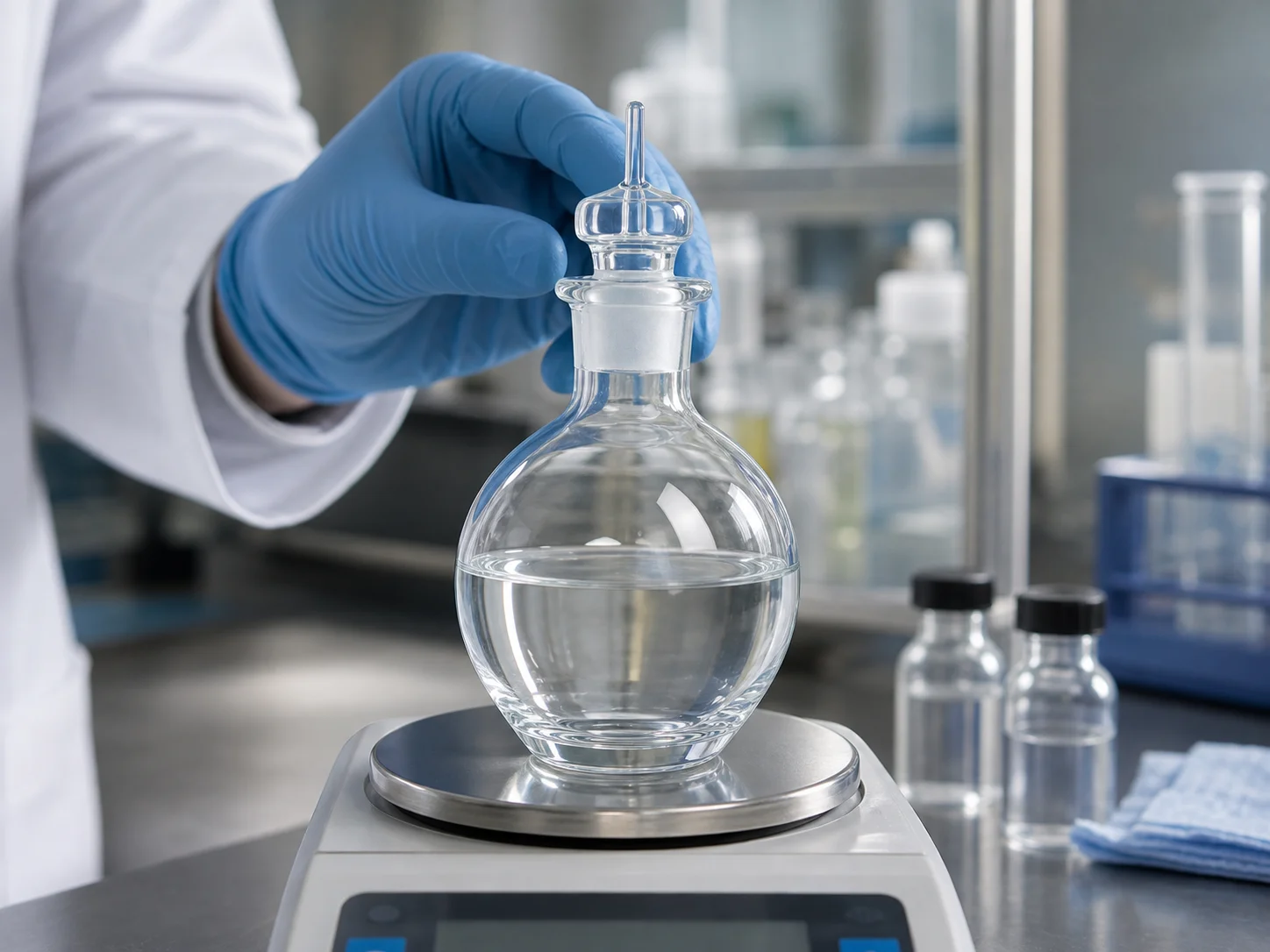
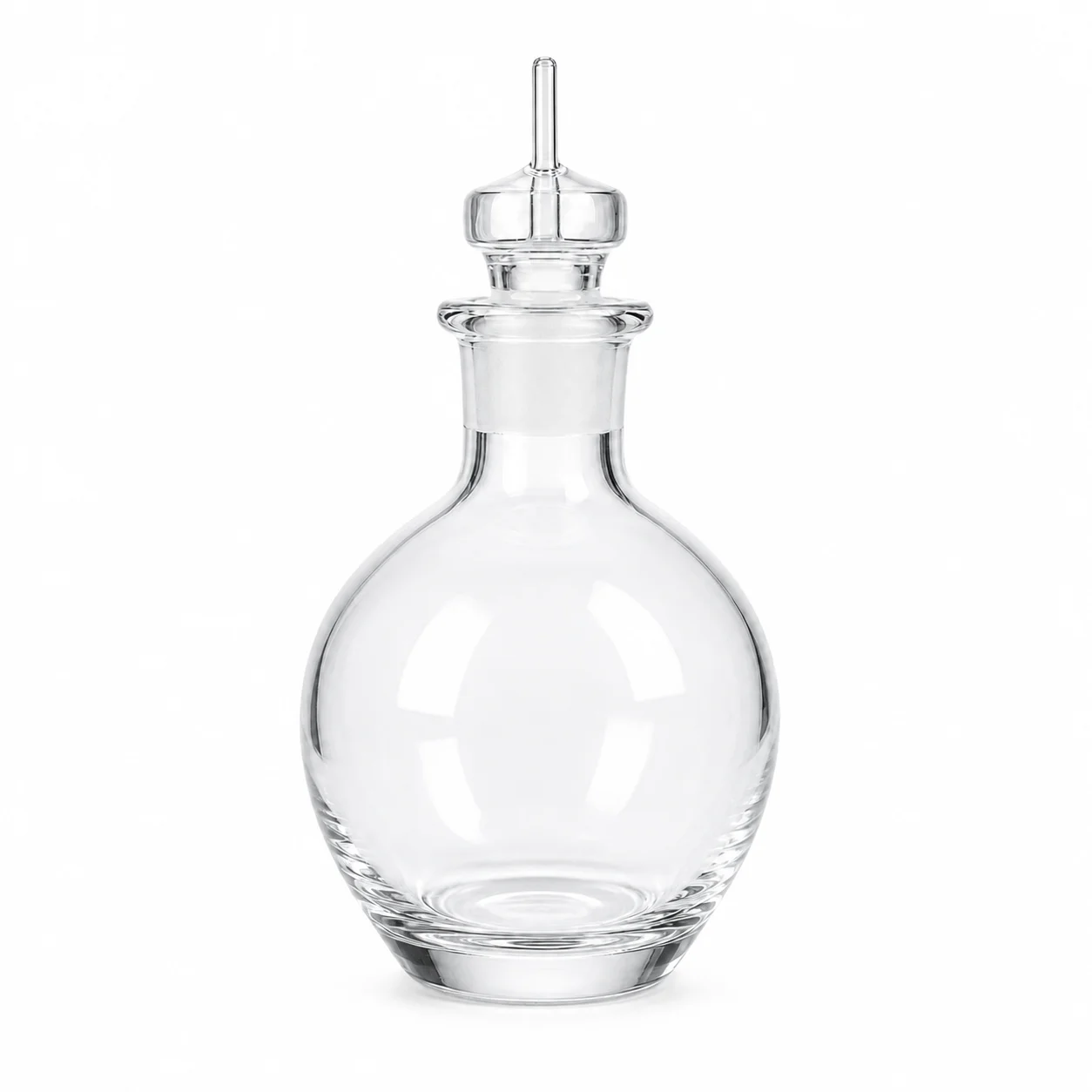
Small spherical glass vessel with a ground stopper carrying a slender capillary tube
Shown configuration · vessel with stopper / calibration record, liquid and thermostat not shown

Density measurement

Pycnometer

A pycnometer of fixed internal volume, filled to a capillary in its ground stopper so that density is obtained by weighing rather than by reading a scale.

Capillary in the stopperVolume fixed by the pairDensity by weighing
Stock status
In stock
Lead time
2–3 weeks
FOB price / pc
$0.70 - $1.05
MOQ
2,000 pcs

Final availability, dimensions, materials, assembled components and commercial terms are confirmed against the selected drawing and approved sample.

No meniscus to judge

Excess liquid leaves through the capillary

Calibrated with water

Its own volume is measured, not assumed

Temperature is the variable

Density work lives or dies on it

Pycnometer profile

The instrument removes the two things people read badly: a meniscus and a scale.

Calibration, temperature control & technique

Five steps that make the number trustworthy.

A pycnometer holds one fixed volume. Fill it, insert the stopper, let the excess escape through the capillary, wipe it and weigh. Density follows from mass and a volume established by weighing the same vessel full of water at a known temperature. There is no line to judge and no graduation to interpolate, which is exactly the point.

01

The volume is measured, not taken from the label

A pycnometer's nominal capacity is a description. Its working volume is established by weighing it empty and then full of distilled water at a stated temperature, and calculating from the density of water at that temperature. That calibration belongs to the individual vessel and its own stopper, and it is repeated whenever either is replaced or the vessel is damaged.

02

Temperature control is the dominant error

Liquid density changes by roughly a tenth of a percent per degree for many organics, which swamps the precision of any balance likely to be used. Serious work therefore thermostats the filled pycnometer in a bath, wipes it dry and weighs it quickly. Filling at room temperature and weighing whenever convenient produces a number with no useful precision.

03

The capillary sets the fill, so it must be clear

Excess liquid leaves through the bore in the stopper as it is seated, which is what defines the volume reproducibly. A capillary partly blocked by dried sample, or a bubble trapped under the stopper, leaves the vessel overfilled or underfilled in a way that no amount of careful weighing detects. Cleaning is a measurement step here, not housekeeping.

04

Stopper and body are one instrument

The ground joint and capillary are lapped to that body, and the calibration is for that pair. Swapping a stopper between two pycnometers invalidates both calibrations at once, silently. Numbered pairs and a habit of never separating them in a washing-up tray are what keep a set of pycnometers usable rather than nominally identical.

05

Wiping technique changes the fourth decimal

After thermostatting, the outside carries a film that weighs. Wiping too vigorously draws liquid back out of the capillary; wiping too lightly leaves the film on. A consistent routine — same cloth, same order, same time — matters more than which routine is chosen, because density work is comparative and repeatability outranks any single absolute reading.

06

Buoyancy and sequence both enter the result

Weighings are made in air, which supports the instrument by the mass of the air it displaces, and that correction matters at the precision a pycnometer is bought for. Empty, water-filled and sample-filled weighings are taken in one session on one balance so that ambient conditions do not drift between them.
Application guide

A vessel of exactly known volume, filled exactly full.

A pycnometer measures density by holding a precisely known volume: fill it, weigh it, and the mass difference gives the answer. Everything depends on that volume being reproducible to the same point every time. These are development directions confirmed against the method.

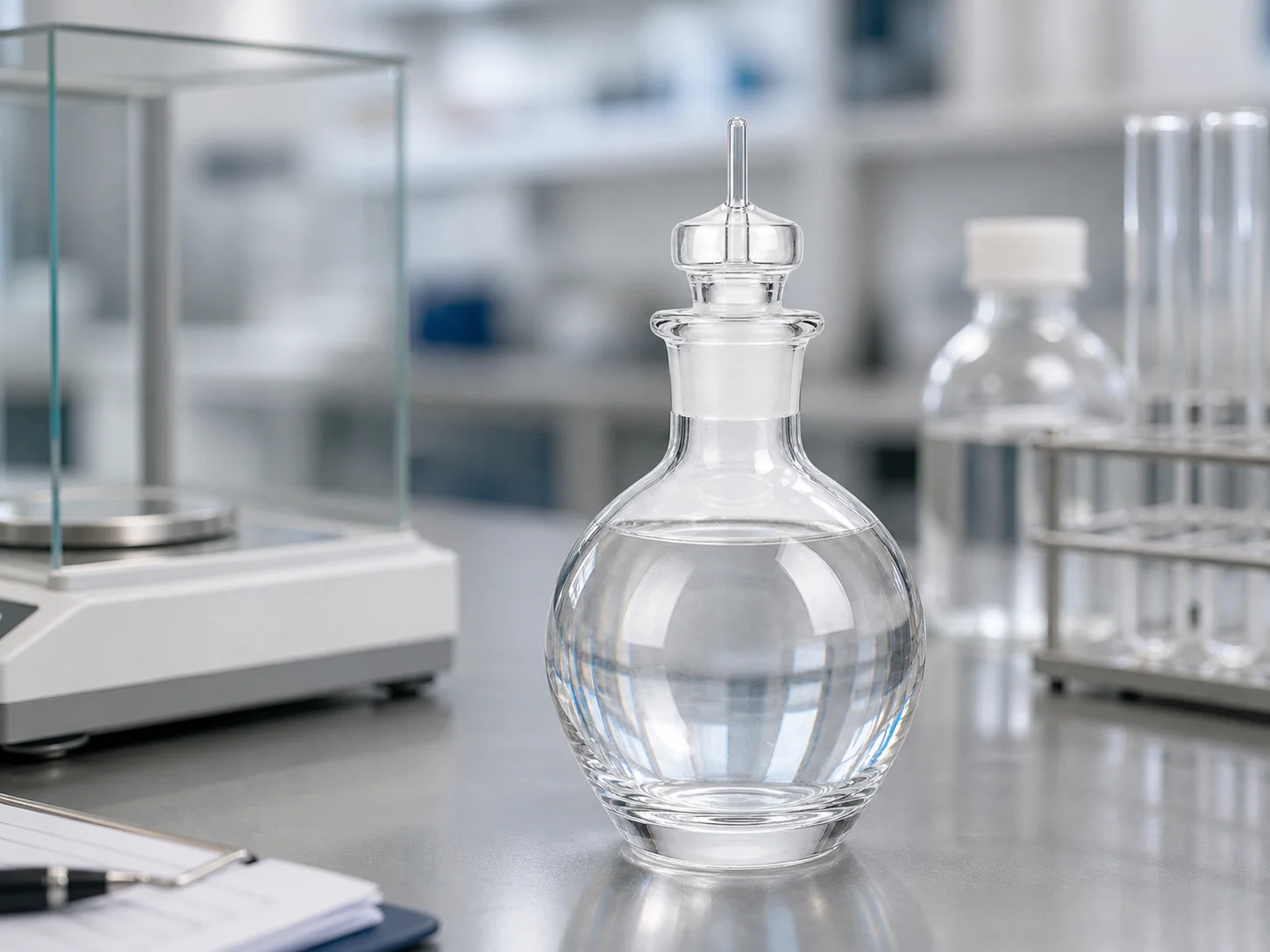
Pycnometer used for liquids weighed at a fixed volume in a density determination setting

Density determination

Liquids weighed at a fixed volume

For determining density by weighing the vessel empty and then full at a controlled temperature. The capillary in the stopper defines the fill point exactly, letting excess liquid escape so the same volume is captured on every determination regardless of who performs it.

  • Fill to the capillary every time
  • Control temperature during the weighing
  • Confirm the calibrated volume
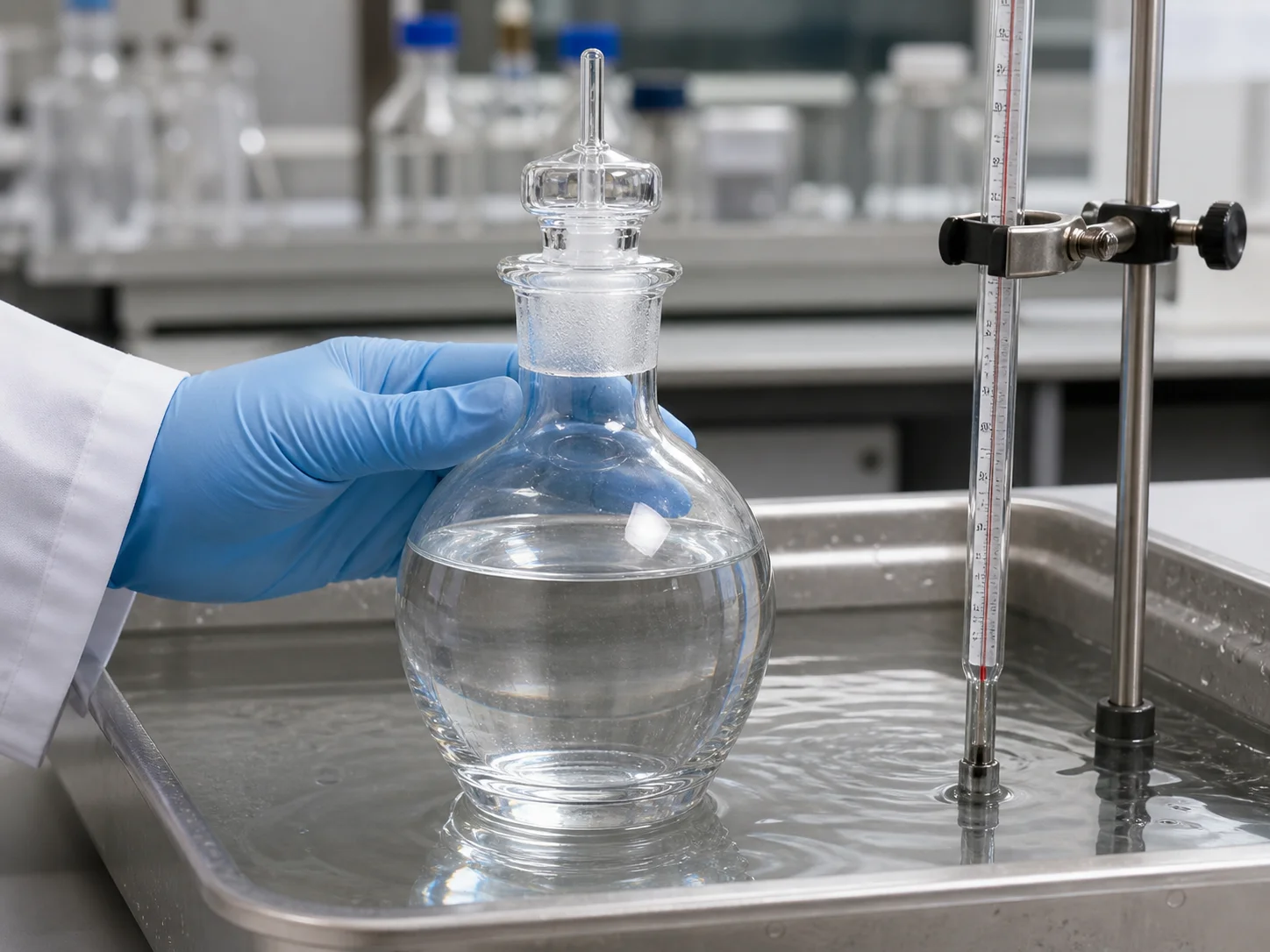
Pycnometer used for volume that changes with a few degrees in a temperature setting

Temperature

Volume that changes with a few degrees

Both the liquid and the glass expand with temperature, so a determination made in a warm laboratory differs from one made in a cool one. Working in a controlled bath and recording the temperature is part of the method rather than an added refinement.

  • Equilibrate in a temperature bath
  • Record the temperature with the result
  • Use the same temperature for all steps
Pycnometer used for the stopper is part of the volume in a matched stopper setting

Matched stopper

The stopper is part of the volume

Because the capillary bore in the stopper is what sets the exact fill point, the stopper and the body are calibrated together as a single unit, and swapping stoppers between vessels quietly invalidates the calibration of both. They are marked as matched pairs for exactly that reason, and the marking has to be respected.

  • Never swap stoppers between units
  • Keep the marked pair together
  • Recalibrate if a stopper is replaced

Applications describe workflow directions. Accuracy, calibration and laboratory outcomes are confirmed for the selected program.

Common questions

Pycnometer questions

Density by weighing is simple. The precision comes from the discipline around it.

Can we swap stoppers between pycnometers?

Not without invalidating both calibrations, and it happens silently. The ground joint and capillary are lapped to one body, and the calibration is for that pair. Number the pairs and never separate them in a washing-up tray. It is the single most common way a set of pycnometers becomes a set of vessels with unreliable volumes.

Why does the result drift when the vessel is clean?

Look at the capillary. Excess liquid leaves through the bore as the stopper is seated, and that is what defines the volume reproducibly. A bore partly blocked by dried sample, or a bubble trapped beneath the stopper, leaves the vessel over or underfilled in a way careful weighing will not reveal. Cleaning is a measurement step here.

How should the outside be wiped before weighing?

Consistently. After thermostatting, the outer surface carries a film that weighs; wiping hard draws liquid back out of the capillary, wiping lightly leaves the film. Which routine you adopt matters less than using the same cloth, the same order and the same timing every time, because density work is comparative and repeatability outranks absolute technique.

Does buoyancy enter the calculation?

It does at this level of precision, and so does the weighing order. Air buoyancy on the filled and empty vessel differs enough to move the result, so the sequence of weighings and the correction are both part of the method rather than refinements.

Next step

Send us the Pycnometer brief.

Tell us the product, fill volume, closure preference and destination market. We will come back with the matching drawings, available configurations and a sample plan before anything is quoted.

  • 01Send the briefProduct, volume, closure and market
  • 02Get the optionsMatching drawings and configurations
  • 03Approve the sampleConfirm the pack before production