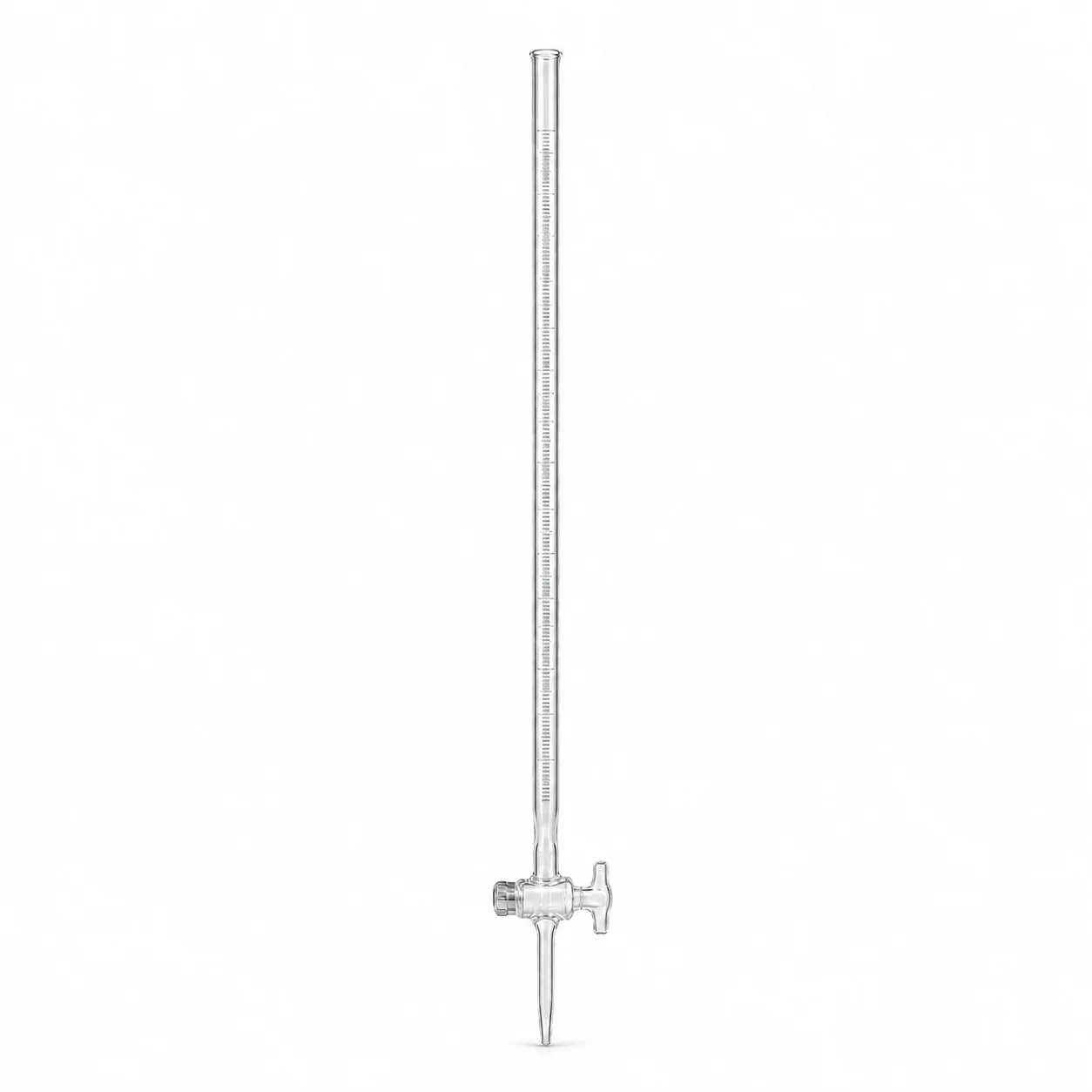
Tall graduated burette with fine scale divisions, a stopcock at the foot and a tapered delivery tip
Shown configuration · burette barrel and stopcock / stand, clamp and titrant not shown

Volumetric glassware

Glass Burette

A graduated burette in borosilicate 3.3 with a stopcock at the foot, held to ISO 385 Class A limits of ±0.030 mL at 25 mL and ±0.050 mL at 50 mL.

Class A ±0.05 mL at 50 mLGlass or PTFE stopcockCalibrated to deliver
Stock status
In stock
Lead time
2–3 weeks
FOB price / pc
$0.75 - $1.15
MOQ
3,000 pcs

Final availability, dimensions, materials, assembled components and commercial terms are confirmed against the selected drawing and approved sample.

Read the drop, not the level

Scale divides finely enough to split a drop

Two stopcock materials

Ground glass needs grease; PTFE does not

Drain time is specified

Wait after delivery before reading

Glass Burette profile

The only volumetric vessel where the operator's technique is part of the tolerance.

Class limits, stopcock choice & drainage

Where the error actually comes from in a titration.

A burette measures by difference: it is read before and after delivering, so its accuracy depends on two readings and on what stays behind on the wall between them. ISO 385 sets the tolerance of the glass, but the film left by a slow drain, a greased stopcock or a hurried reading can exceed that tolerance without any fault in the instrument.

01

Class A limits are tighter than most people assume

ISO 385 puts Class A at ±0.020 mL for a 10 mL burette, ±0.030 mL at 25 mL, ±0.050 mL at 50 mL and ±0.100 mL at 100 mL. Since a drop from a standard tip is roughly 0.05 mL, the tolerance of a 50 mL Class A burette is about one drop across its whole length. That is the scale on which everything else has to be controlled.

02

PTFE and ground-glass stopcocks fail differently

A ground-glass key needs grease, and grease creeps into the bore, contaminates the titrant and eventually blocks the tip. A PTFE key runs dry, cannot seize and is unaffected by alkali, but it creeps under load, so the nut needs occasional adjustment. Laboratories running strong bases almost always move to PTFE, since alkali fuses ground glass shut.

03

Delivery is calibrated with a waiting time

A burette is calibrated to deliver, and the delivered volume assumes the film on the wall has been given time to drain down. Reading immediately after closing the stopcock reports a volume that is still partly on the glass. Standard practice allows a short settling period — commonly around 30 seconds — before taking the final reading, and applies it consistently across every titration.

04

The tip does as much as the barrel

A jet drawn too fine slows the delivery until an analyst starts rushing; too coarse and half-drops become impossible to split. Tip geometry also decides whether the last drop hangs and has to be rinsed into the flask. When burettes from two suppliers give different endpoints on the same titration, the tip is where to look before questioning the calibration.

05

The Schellbach stripe is a reading aid, not decoration

A blue stripe fused into the back of the barrel appears through the meniscus as two arrowheads meeting at the liquid surface, which removes much of the judgment from reading a curved surface in poor light. It costs more to make and it is the single most useful option on a burette used by students or by anyone reading at speed.

06

Alkali will destroy a burette quietly

Sodium hydroxide attacks glass surfaces slowly and etches the graduation lines and the stopcock seat first. A burette used for base titrations and left standing full will develop a stopcock that seizes and a scale that becomes hard to read within months. Draining and rinsing after every session is what keeps a burette in class rather than in a drawer.

Application guide

Delivering a volume you read twice and subtract.

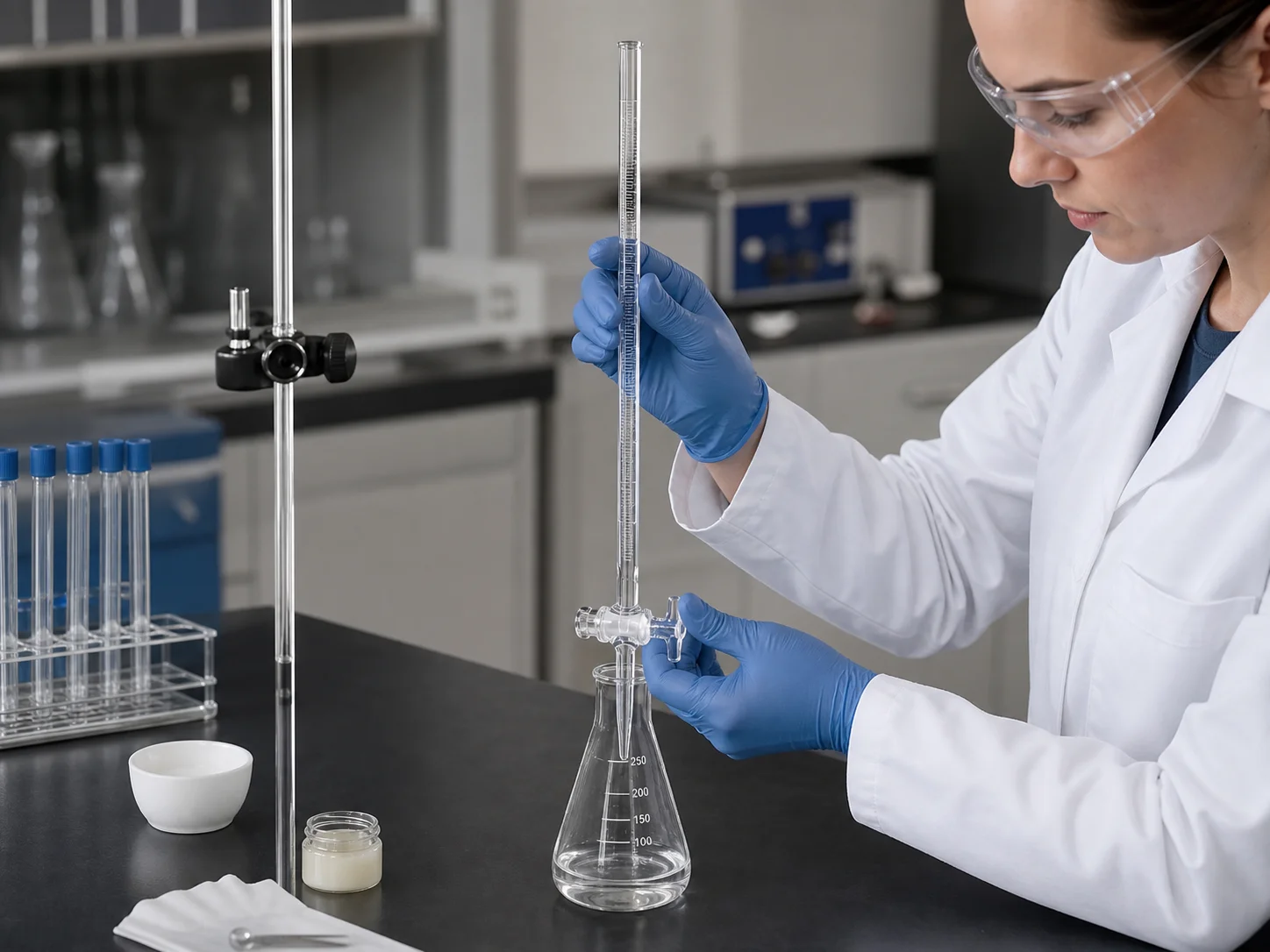
A burette measures by difference: an initial reading, a final reading, and the volume delivered between them. Accuracy therefore depends on the scale, the stopcock and the operator equally. These are development directions confirmed against the method.

Glass Burette used for reagent added drop by drop to an endpoint in a titration setting

Titration

Reagent added drop by drop to an endpoint

For titrations where reagent is run in until an indicator changes, sometimes a fraction of a drop before the endpoint. The stopcock has to allow that fine control, and the operator reads the meniscus at eye level both before starting and after stopping to get the delivered volume.

  • Confirm the tap gives drop control
  • Read the meniscus at eye level
  • Record both readings, not the total
Glass Burette used for ground glass or polymer, and what each costs in a stopcock setting

Stopcock

Ground glass or polymer, and what each costs

A ground-glass tap needs grease and periodic attention but resists solvents that would swell a polymer plug; a polymer plug runs dry and needs no maintenance but has chemical limits. The choice follows from the reagents and from how the laboratory maintains equipment.

  • Choose the tap for the reagents used
  • Confirm the maintenance route
  • Check for leakage past the plug
Glass Burette used for a burette taken from the next bench in a borrowed glassware setting

Borrowed glassware

A burette taken from the next bench

For the analyst whose own burette is in the wash and who picks up whichever one is free. They are made to different tolerance classes, and a titration written around the tighter one keeps producing tidy numbers with a bias nobody sees, so the class comes from the method and the certificate stays with the glass.

  • Establish the class the method needs
  • Confirm what is actually supplied
  • Retain calibration documentation

Applications describe workflow directions. Accuracy, calibration class and laboratory outcomes are confirmed for the selected program.

Common questions

Glass Burette questions

Burette error is usually procedural. These questions separate the glass from the technique.

Which stopcock suits a burette?

PTFE for almost every modern laboratory. It runs dry, so no grease creeps into the bore or contaminates the titrant, and alkali cannot seize it. The trade is that PTFE creeps under load and the nut needs occasional adjustment. Ground-glass keys are still used where a specific solvent attacks PTFE seals, but they demand greasing discipline that most labs no longer keep.

Why wait before taking the final reading?

Because a burette is calibrated to deliver, and the delivered volume assumes the film clinging to the wall has drained. Reading the instant the stopcock closes reports liquid that is still on the glass. A short settling period, commonly around thirty seconds, is applied consistently to every titration — the consistency matters as much as the exact interval chosen.

What is the blue stripe down the back?

A Schellbach stripe. Seen through the meniscus it appears as two arrowheads meeting at the liquid surface, which takes most of the judgment out of reading a curved surface under poor lighting. It costs more to manufacture and it is the most worthwhile option on any burette used by students or by an analyst reading quickly under routine pressure.

What does alkali do to a burette?

It etches the scale away quietly. Standing alkali attacks the glass surface, so graduations fade and stopcocks seize over months without any single event to point at. Empty and rinse after alkali work rather than leaving solution standing.

Next step

Send us the Glass Burette brief.

Tell us the product, fill volume, closure preference and destination market. We will come back with the matching drawings, available configurations and a sample plan before anything is quoted.

  • 01Send the briefProduct, volume, closure and market
  • 02Get the optionsMatching drawings and configurations
  • 03Approve the sampleConfirm the pack before production