
Lug engagement, plastisol lining & vacuum retention
Why a lug closure is far less forgiving of a mis-set line than a screw cap.
A lug cap engages four or six short ribs on the glass and is turned down less than a full revolution. What holds the jar shut afterwards is atmospheric pressure acting on a vacuum drawn during filling, with a soft plastisol gasket taking up the difference between a metal shell and a glass sealing surface that is never perfectly flat.
Four lugs carry what a thread spreads over a full turn
A continuous thread distributes load along its whole helix, so a slightly misaligned cap still finds the thread and pulls down. Lugs make contact at four or six discrete points, and a cap presented at the wrong angle rides up one rib and cross-loads the rest. That is why the application head angle is set against filled jars rather than against a component drawing.
Take the lug count from the diameter
Sizes through 63 mm are normally built on four lugs; 70 mm and 82 mm move to six because the wider panel needs more points of restraint to stay square under vacuum. The count is part of the finish specification on the glass side too, so a 70 mm jar tooled for six lugs will not accept a four-lug cap even though the diameters agree.
The gasket is poured, not punched
Plastisol is a liquid PVC compound spun into the curl of the shell and heat-cured into a soft ring. Because it is formed in place rather than cut from sheet, it flows into the exact profile of the sealing surface as the cap is applied warm — which is how a metal shell manages a hermetic seal against glass that carries mold seams and minor variation.
Let the liner temperature limit set the process
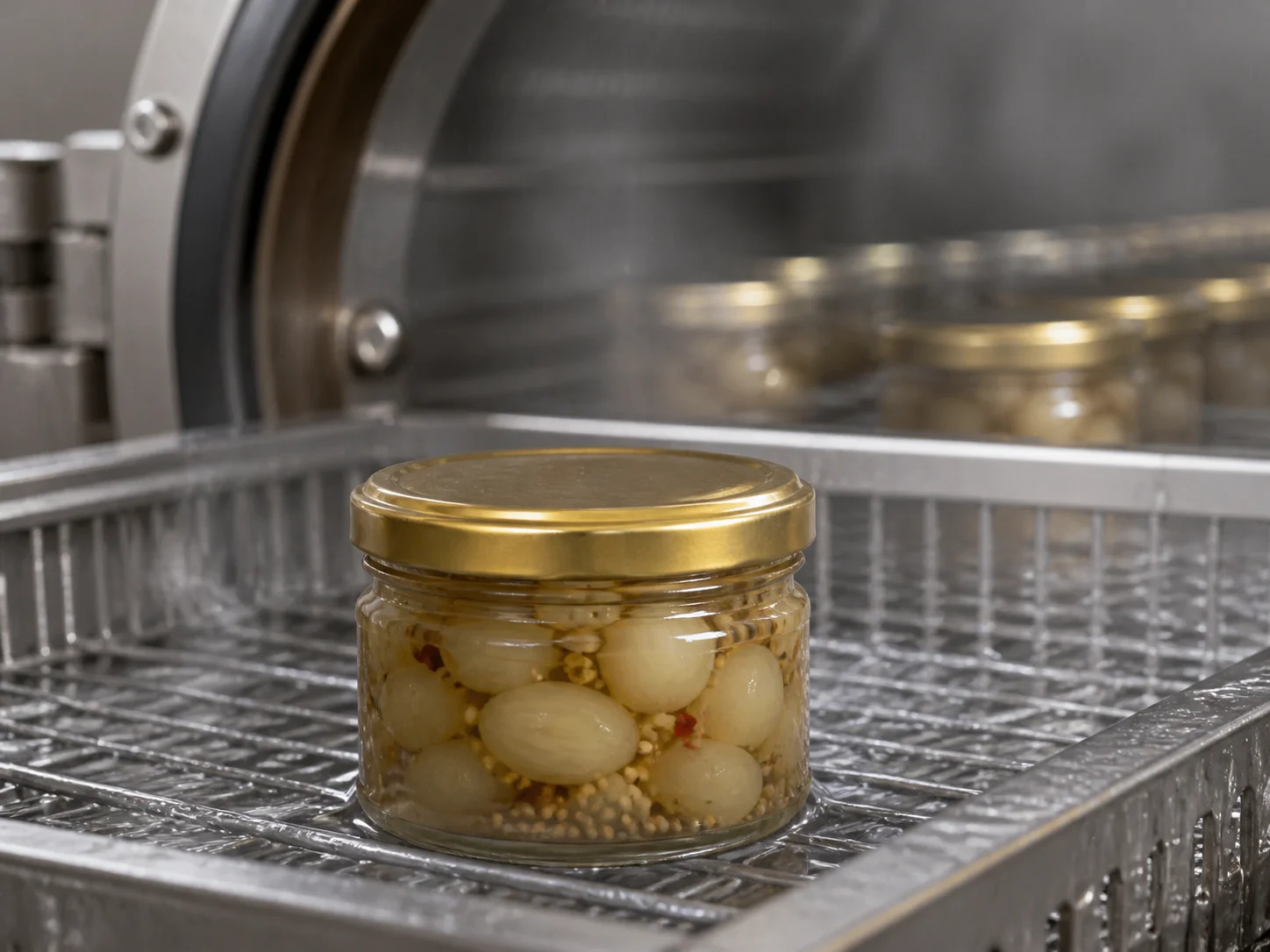
Plastisol linings are generally rated to around 88 °C, which comfortably covers hot fill and tunnel pasteurization but stops short of retort. Where a product needs full sterilization, the compound specification changes and the cap becomes a different part number. Deciding the thermal process before choosing the cap avoids re-tooling a program after the first production trial.
The button reports the vacuum, nothing else
A domed panel pulled flat by the internal vacuum gives the customer a visible and audible check, and gives the packer an inline reject signal. It reports pressure difference only: a jar can hold a good vacuum with a marginal seal that will fail slowly over months. Shelf-life work therefore tracks vacuum decay over time rather than the button on day one.
Print before stamping, and plan the stacking bead
Shells are lithographed flat and then pressed, so decoration is a sheet cost spread across a full print run and short color changes are expensive. The rolled bead around the panel is functional as well as visual — it stiffens the top against vacuum and lets filled jars stack without the cap taking point loads through the pallet.