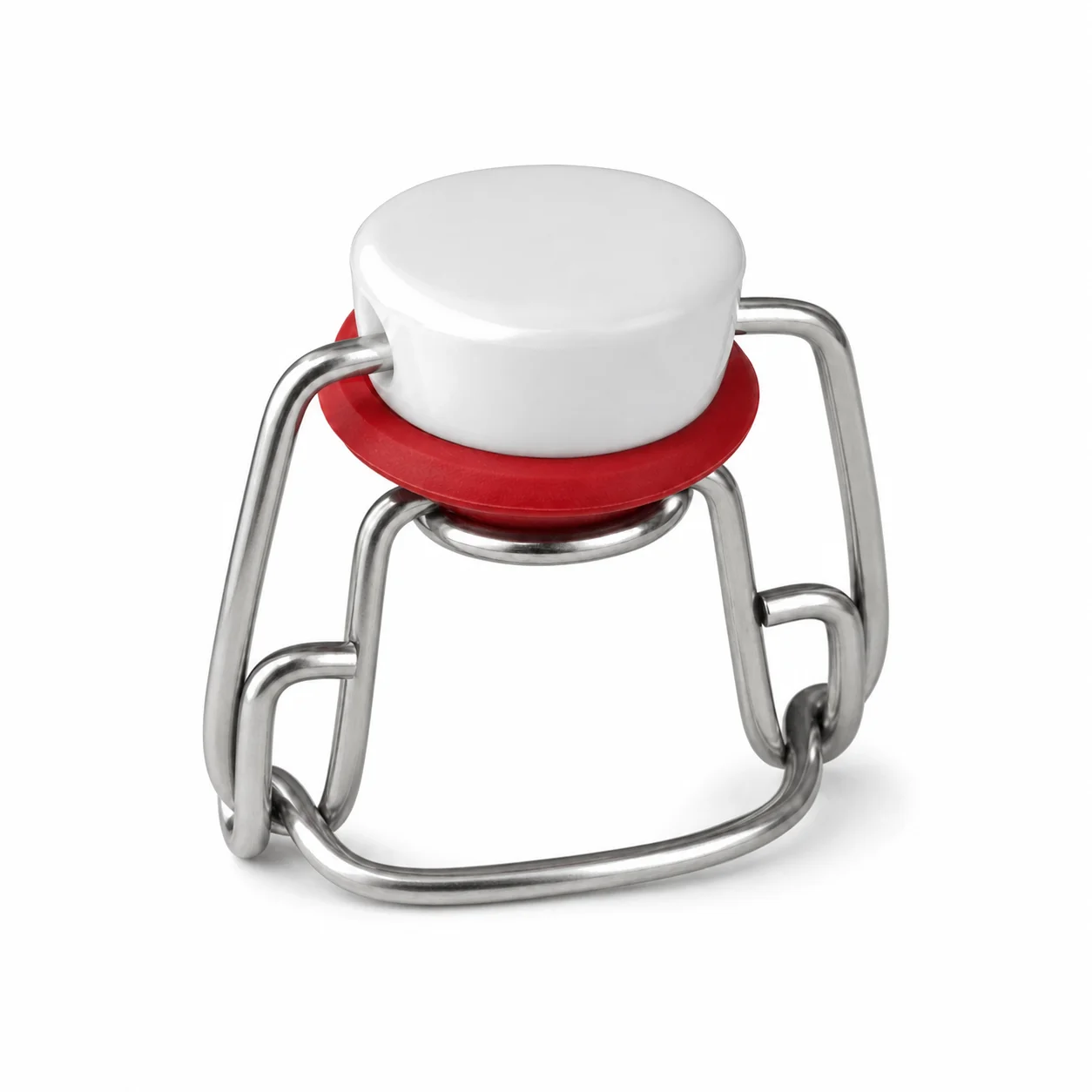
Swing-top closure with a white stopper head, red gasket ring and articulated steel wire bail, shown loose without a bottle
Shown configuration · white head with red gasket and wire linkage / bottle, neck bead and closed position not shown

Mechanical bail closures

Swing-top Clip Closure

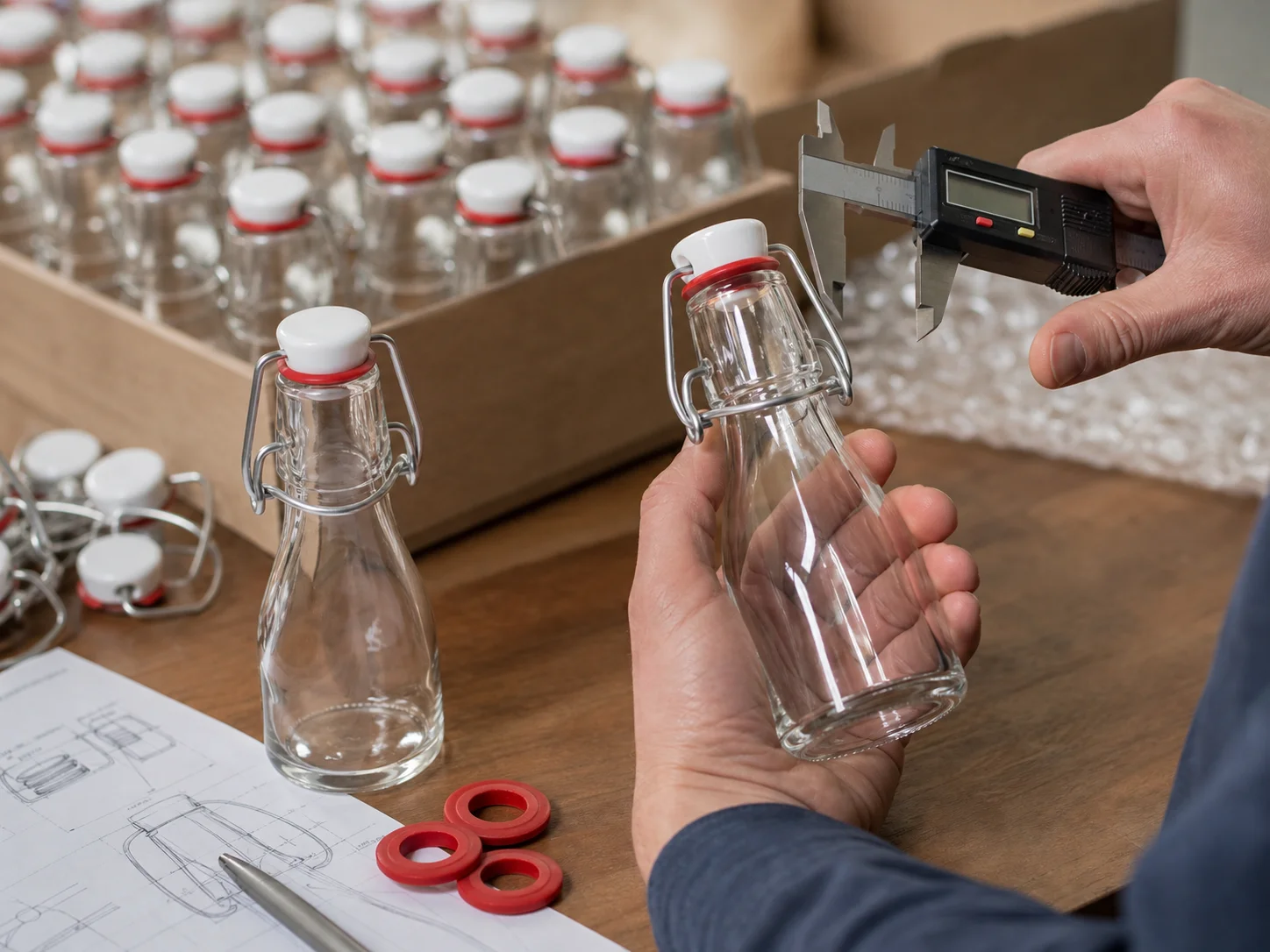
A three-part lever closure — stopper head, elastomer gasket and steel wire bail — that clamps onto a formed neck bead and reseals by hand, over and over.

Stopper, gasket and bailAnchors on a neck beadGasket replaceable in service
Stock status
In stock
Lead time
2–3 weeks
FOB price / pc
$0.70 - $1.10
MOQ
10,000 pcs

Final availability, dimensions, materials, assembled components and commercial terms are confirmed against the selected drawing and approved sample.

Nothing to lose

Bail stays captive on the bottle between uses

Top-face seal

Lever force compresses the gasket onto the rim

Serviceable part

Gaskets sold as a spare for refill programs

Swing-top Clip Closure profile

A closure that only works because the bottle was designed around it.

Linkage geometry, gasket service life & the neck bead

Why swing tops are quoted with the bottle and never as a loose closure.

The swing top is three parts working as a linkage: a head that sits on the rim, a gasket that takes the seal, and a wire bail that levers the head down and holds it there. Unlike a screw cap it does not thread onto a finish — it hooks under a bead formed into the neck, which means the bottle and the hardware are one design decision.

01

The bead on the neck is the real interface

A screw closure meets the bottle at a standard finish that any supplier can make. A swing top hooks its wire under a retaining bead whose diameter, height and distance below the rim are particular to that bottle mold. Two bottles that both take a 'standard' swing top can hold the head at different heights, and that difference alone decides whether the gasket is compressed or merely touching.

02

Lever force, not thread torque, makes the seal

Closing the bail pushes the head down past an over-center point, so the linkage holds itself shut with the gasket under permanent compression. There is no torque to specify and no capper setting to record. What matters instead is the geometry of the linkage arms, because a millimeter of extra arm length changes the clamping force far more than it changes how the closure looks.

03

Treat the gasket as a consumable

Natural rubber and silicone rings both take a compression set: after enough cycles the ring stays flattened and stops springing back onto the rim. Silicone holds up better through hot washing and holds no odor from strongly flavored products; rubber costs less and grips slightly better when cold. Either way, a refill program needs spare gaskets on the shelf from day one.

04

Pick the head material for how it will be washed

Traditional porcelain heads are heavy, cool to the touch and survive dishwashing indefinitely, which is much of why the format still reads as premium. Molded heads in food-grade plastic cost less, chip less in a warehouse and let a brand color match the closure, but a thin head can distort under repeated hot wash cycles and lose the flat bearing face the gasket needs.

05

The wire fatigues before anything else

Stainless bails resist corrosion in a wet cellar or refill shop; galvanized wire is cheaper and adequate on a dry line. Both fail the same way — the pivot bends open slightly with every cycle until the head no longer pulls down square. Counting cycles on real bottles, rather than judging by feel on a fresh sample, is the only way to know how many refills a program can promise.

06

Carbonation is a bottle question first

The bail happily holds a carbonated beer or kombucha, and the format was popularized on exactly that duty. The pressure limit, though, belongs to the glass: wall thickness, base design and annealing decide what a bottle survives. A closure that keeps holding while the bottle is overpressurized is the least useful kind of strong, so pressure figures are taken from the bottle specification.

Application guide

A wire mechanism that stays attached to the bottle.

The swing-top clamps a gasketed stopper down with a lever, and because the whole assembly is captive nothing gets lost between uses. It is chosen where a bottle is opened and closed many times. These are development directions confirmed on the actual bottle.

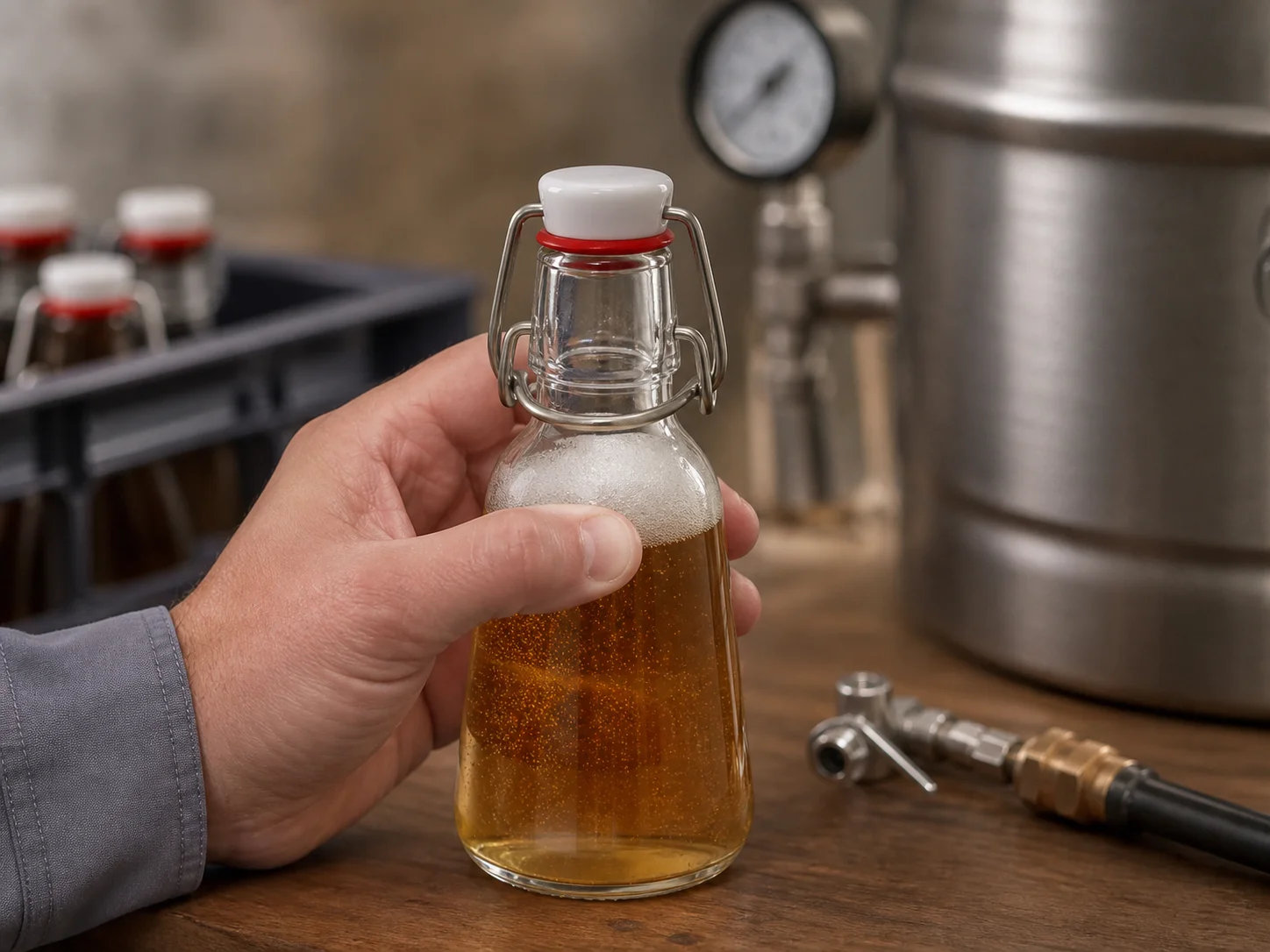
Swing-top Clip Closure used for bottles resealed under pressure in a home brewing and beverages setting

Home brewing and beverages

Bottles resealed under pressure

For brewers and beverage producers whose bottles are opened, resealed and sometimes hold carbonation between uses. The lever gives a firm mechanical clamp that a customer can operate one-handed, and the gasket does the actual sealing under that force.

  • Confirm the clamp holds carbonation
  • Test one-handed operation
  • Match the gasket to the product
Swing-top Clip Closure used for the same bottle brought back every week in a refill stations setting

Refill stations

The same bottle brought back every week

For shops selling oil, vinegar or detergent by refill, where a customer returns the same bottle dozens of times a year. The glass outlives the hardware by a wide margin: wire frames fatigue, pivots loosen and gaskets take a set, so the program needs replacement gaskets on the shelf and a rough idea of how many cycles the frame survives.

  • Cycle real bottles to failure
  • Stock replacement gaskets
  • Confirm the wire resists fatigue
Swing-top Clip Closure used for a bottle or a frame sourced separately in a changing supplier setting

Changing supplier

A bottle or a frame sourced separately

For a buyer who has been running swing-tops for a season and is asked to move the bottle or the hardware to a second supplier on price. The wire seats on features formed into the neck itself, so the two parts are one system, and swapping either without re-checking the other is where these programs come unstuck after production has started.

  • Treat bottle and frame as one system
  • Confirm the neck features match
  • Recheck if either part changes

Applications describe closure-development directions. Fit, clamping force, retention, sealing, leakage, cycle life and regulatory outcomes are confirmed for the selected program.

Common questions

Swing-top Clip Closure questions

The questions that come up once a buyer treats the swing top as hardware rather than as a cap.

Can I buy swing-top hardware for a bottle I already have?

Only if that bottle was molded with a swing-top neck. The bail hooks under a retaining bead formed into the glass, and the bead diameter, its height and its distance below the rim all vary between molds. Send the neck drawing or a sample bottle and the linkage can be matched to it; without the bead there is nowhere for the wire to anchor.

Rubber or silicone for the gasket?

Silicone survives hot washing and repeated dishwasher cycles better and picks up less odor from spirits, chili oils or strongly aromatic ferments. Natural rubber is cheaper and stays slightly grippier when cold, which suits chilled beverages that are not washed between fills. Both take a compression set in the end, so the real difference is how many cycles you get before replacement.

How often do gaskets need replacing?

There is no fixed interval, because the ring fails by staying flattened rather than by tearing. Programs that wash and refill weekly usually plan on replacement within a season; a bottle filled once and sold does not need a spare at all. If you are running refills, stock gaskets from the start rather than adding them after the first complaints arrive.

What torque should we cap it at?

None. There is no thread anywhere in the seal path, so nothing on a swing-top line is torqued. The closure snaps past an over-center point and holds itself down, and the equivalent quality check is how much force it takes to lift the bail and whether the head bears square on the rim after cycling.

Which part fails first?

The wire. Gaskets are consumable and expected to be replaced, but the bail work-hardens through repeated levering and eventually fatigues at the bends. On a returnable or refill program, plan the wire as the life-limiting component.

Next step

Send us the Swing-top Clip Closure brief.

Tell us the product, fill volume, closure preference and destination market. We will come back with the matching drawings, available configurations and a sample plan before anything is quoted.

  • 01Send the briefProduct, volume, closure and market
  • 02Get the optionsMatching drawings and configurations
  • 03Approve the sampleConfirm the pack before production