Hydrolytic classification, surface treatment & durability
Six distinctions that keep a glass specification honest.
Pharmaceutical glass is classified by how much alkali it releases into water under defined conditions. Borosilicate reaches Type I, treated soda-lime reaches Type II and untreated soda-lime is Type III. Choosing between them is a formulation decision, and it does not settle every glass question — inner-surface durability is assessed separately.
The classes describe a test, not a material claim
Hydrolytic resistance is measured by extracting crushed glass or a filled container under defined conditions and titrating what came out. ISO 719 runs at 98 °C and ISO 720 at 121 °C, and the pharmacopeial Type I, II and III designations rest on that kind of measurement. A glass is Type I because it passed a test, not because of its name.
Type II is treated soda-lime, and treatment can wear
Type II is soda-lime glass whose inner surface has been treated, typically with ammonium sulfate at high temperature, to strip sodium from the surface layer. That gives Type I-like surface performance at soda-lime cost. The treated layer is thin, so repeated autoclaving or aggressive contents can work through it in a way that bulk borosilicate does not experience.
Surface durability is a different question from class
A container can pass its hydrolytic test and still shed glass flakes into a formulation over time, which is why inner-surface durability is evaluated on its own. Low surface alkalinity from a sulfate treatment does not guarantee resistance to that. Formulations at extreme pH, and long storage, are where the distinction becomes practical rather than academic.
Autoclaving is where borosilicate earns its cost
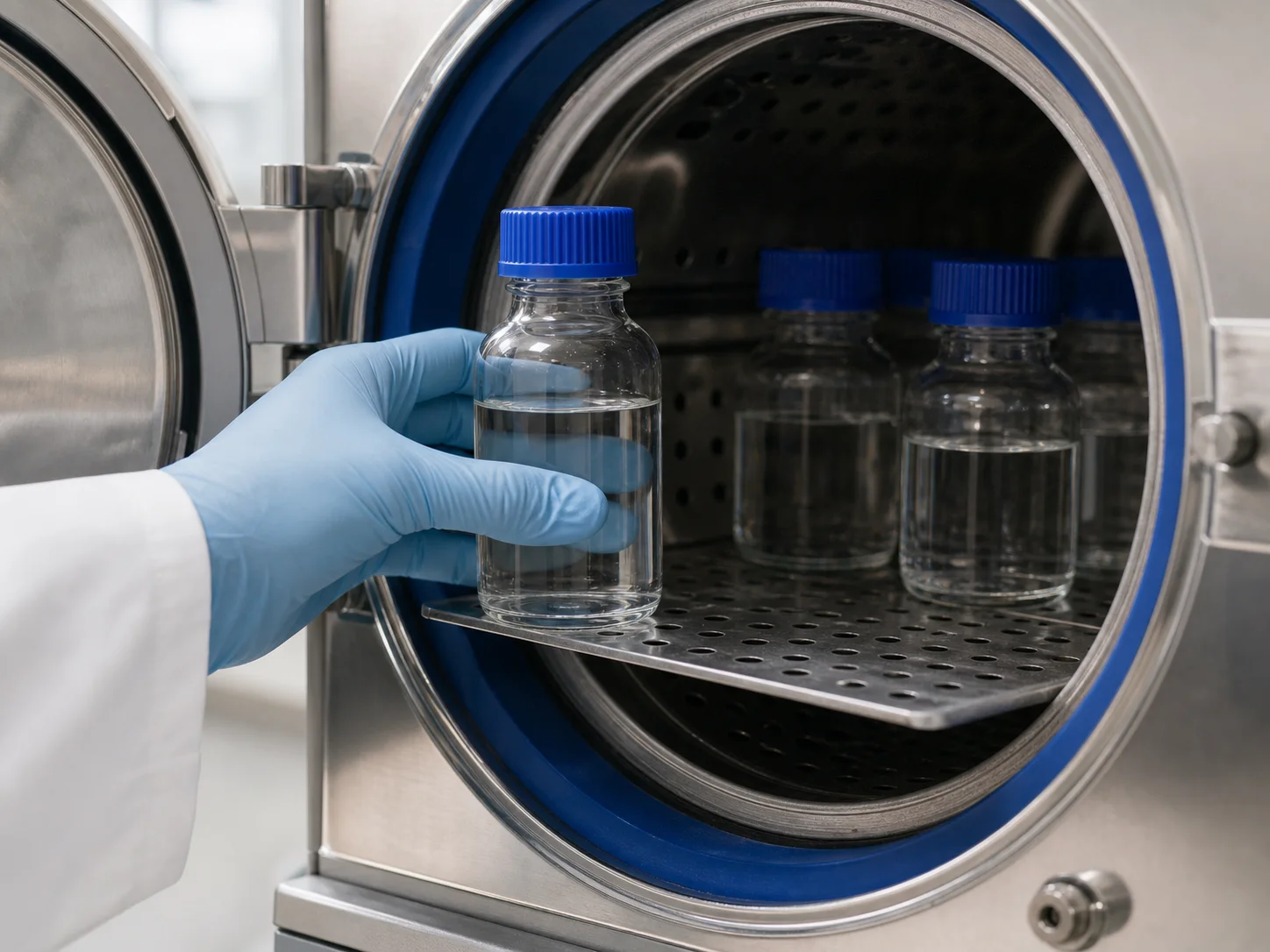
Low thermal expansion lets a borosilicate bottle go through repeated sterilization cycles without the stress that cracks soda-lime, and the bulk composition means no surface treatment can be exhausted. For a pack that is sterilized in-house, repeatedly or at scale, that is often the deciding factor rather than the extraction figure.
The closure is still the weakest chemical link
Type I glass resists nearly everything a pharmaceutical formulation contains, and the cap liner does not. Extractables, sorption of preservatives and moisture transmission all happen at the closure. Specifying Type I glass and then accepting a default liner is a common inconsistency, and it is usually the liner that turns up in a stability investigation.
Delamination is a surface phenomenon with a long fuse
Glass in contact with certain formulations can shed thin flakes from its inner surface after months, and the conditions that cause it are set during forming rather than during filling. It is found by extended storage study on the actual product, and it is one of the reasons a container is qualified rather than simply purchased.