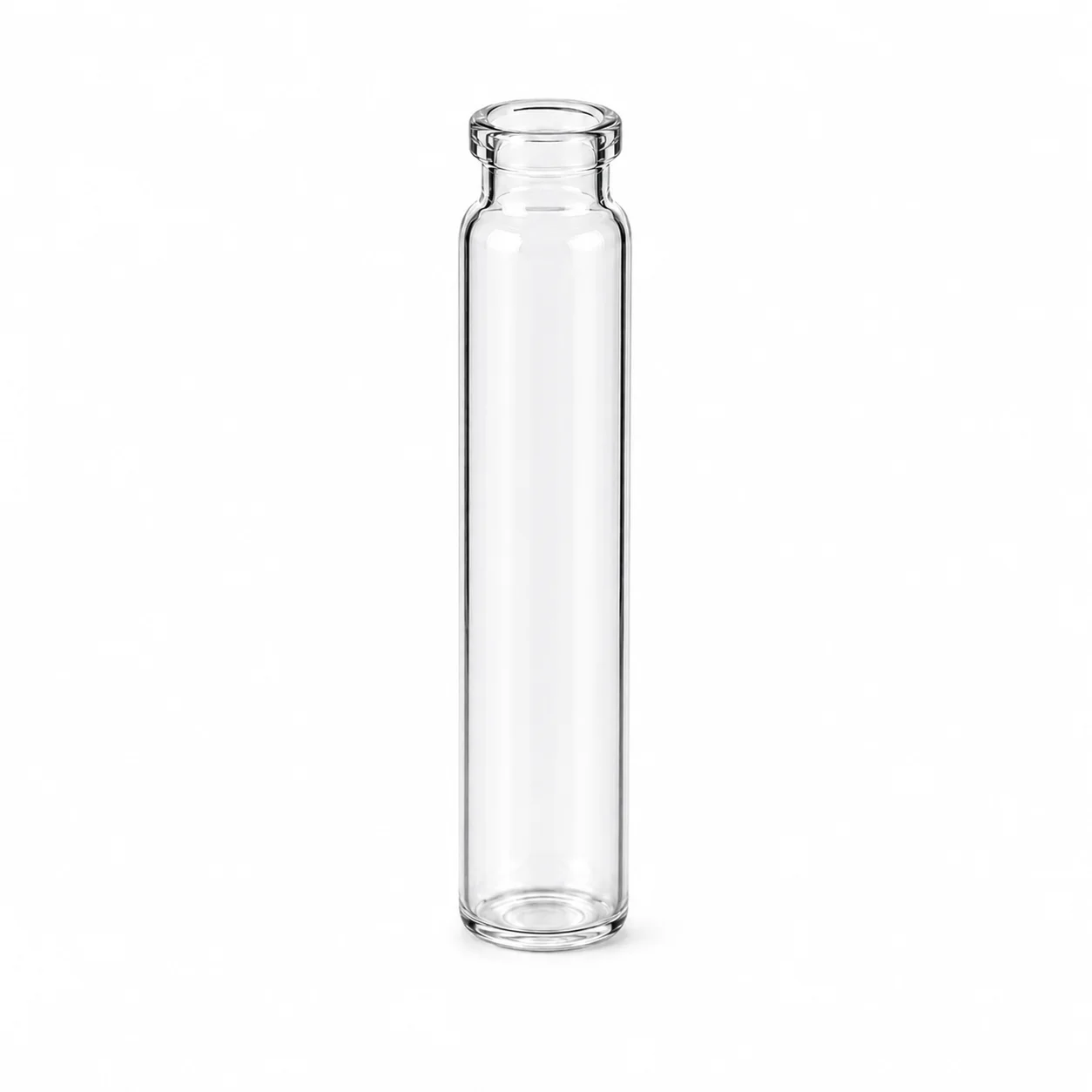
Tall clear cylindrical glass vial with a thick rolled rim and straight parallel wall
Shown configuration · bare vial / stopper, seal, contents and printing not shown

Injection containers

Tubular Vial

A vial drawn from borosilicate tubing to the R series of ISO 8362-1, from 2R to 100R, with a 13 mm or 20 mm crimp finish in blowback and plain neck forms.

2R to 100R series13 mm and 20 mm crimpBlowback and plain necks
Stock status
In stock
Lead time
2–3 weeks
FOB price / pc
$0.40 - $0.80
MOQ
10,000 pcs

Final availability, dimensions, materials, assembled components and commercial terms are confirmed against the selected drawing and approved sample.

Dimensioned by standard

R sizes are interchangeable between suppliers

Thin, even wall

Drawn tubing gives better clarity and heat transfer

Neck form is a choice

Blowback retains the stopper differently

Tubular Vial profile

A container whose dimensions are published, so the machine can be built before the vial arrives.

The R series, neck forms & why tubing is drawn

Six things that decide which vial a filling line will actually accept.

Tubular vials are formed by heating and shaping lengths of borosilicate tubing. That process gives a thin, uniform wall and tight dimensional control, which is why ISO 8362-1 can specify the R series closely enough that filling lines, stoppers and seals are designed around the standard rather than around one supplier's glass.

01

The R designation is a full dimensional specification

ISO 8362-1 defines vials made from glass tubing in the sizes 2R, 4R, 6R, 8R, 10R, 15R, 20R, 25R, 30R, 50R and 100R, with form, dimensions, brimful capacity and mass given for each. Because those figures are published, a line built for 10R vials will run 10R vials from any conforming source, which is the entire point of the series.

02

Brimful capacity is not the labeled volume

The standard states brimful capacity, meaning the vial filled to the top of the neck. Labeled fill volume is always smaller, because headspace is needed for stoppering, for inspection and for freeze-drying if that follows. Reading brimful figures as nominal capacity is a recurring source of confusion when a fill volume is being matched to a vial size.

03

Blowback changes how the stopper is held

The standard covers necks with and without blowback — an internal ridge just below the finish. A blowback neck grips the plunger of the stopper and resists it lifting during freeze-drying or transport; a plain neck relies wholly on the crimp. Which one a program uses has to match the stopper design, and the two are specified as a pair.

04

Tubing gives uniformity that molding cannot

Drawing from tubing produces a thin, even wall with good clarity and consistent heat transfer, which matters for inspection and for lyophilization cycle uniformity. The trade is cost and a limit on how heavy or complex a shape can be made. Where a container needs a thicker wall or a large capacity, a molded vial is the appropriate format instead.

05

Type I is the starting point, not the whole answer

Borosilicate meets the Type I classification for hydrolytic resistance, which is why it dominates injectables. Inner-surface durability is a separate question addressed by evaluating delamination propensity, and a Type I vial is not automatically free of that risk with every formulation. The glass type sets a floor; the formulation decides what else has to be looked at.

06

The finish diameter follows the stopper, not the fill

13 mm necks suit small vials and small closures; 20 mm necks take larger stoppers and give better access for reconstitution and for withdrawal. The decision is made with the stopper and seal supplier because the three components form one closure system, and changing the finish after stopper qualification restarts that work.


Application guide

Tubular glass gives thin, even walls and clear sides.

Drawing a vial from glass tubing rather than molding it produces a thinner, more uniform wall and better optical clarity, which matters when the contents have to be inspected. These are development directions confirmed against the selected drawing.

Tubular Vial used for products checked for particles before use in a visual inspection setting

Visual inspection

Products checked for particles before use

For liquids a pharmacist or clinician holds up to the light looking for particles or discoloration before administering. Thin, even tubular walls give the clarity that inspection depends on, whereas heavier molded glass distorts and makes small particles far harder to see.

  • Confirm clarity supports inspection
  • Check wall evenness on samples
  • Review the vial against a light box
Tubular Vial used for vials packed where every millimeter is paid for in a cold chain shipments setting

Cold chain shipments

Vials packed where every millimeter is paid for

For products moving in validated cold boxes, where a courier charges for the space and someone has to fit a full consignment into it. Thin walls give more dose inside the same footprint, and there is less glass for an autoclave to heat and bring back down again.

  • Balance internal volume against footprint
  • Confirm wall thickness at the base
  • Review cycle behavior for thin glass
Tubular Vial used for a break nobody can simply sweep up in a aseptic rooms setting

Aseptic rooms

A break nobody can simply sweep up

For the operators running these vials through a sterile suite, where the thin wall that makes inspection easy also makes the glass less forgiving of a knock. A breakage there costs a line clearance and an investigation, so tray design and the number of glass-to-glass contacts get reviewed before the first batch.

  • Reduce glass-to-glass contact on the line
  • Design trays to prevent knocking
  • Confirm strength at the selected wall

Application directions are development guidance. Sterility, clinical use and compliance outcomes are confirmed for the selected program.

Common questions

Tubular Vial questions

Six questions that come up whenever a fill volume is matched to a vial size.

Is a 10R vial a 10 mL vial?

Not as a fill volume. The standard gives brimful capacity — the vial filled to the top of the neck — and labeled fill is always lower because headspace is needed for stoppering, inspection and any freeze-drying step. Matching a fill volume to a vial size means working from the fill and the process, not from the number in the size code.

Do we need a blowback neck?

It depends on the stopper and the process. A blowback ridge inside the neck grips the stopper plunger and resists lifting during lyophilization or transport; a plain neck relies entirely on the crimp. The two neck forms suit different stopper designs, so they are chosen together with the closure supplier rather than as a property of the glass alone.

Tubular or molded vial?

Tubing gives a thin, even wall with good clarity and uniform heat transfer, which helps inspection and lyophilization consistency. Molding allows a heavier wall, larger capacities and more complex shapes at lower cost, with wider dimensional variation. The decision usually follows capacity and process before it follows price.

What sets the finish diameter?

The stopper, not the fill volume. The neck is dimensioned around the closure system that has to seat in it, which is why vials of very different capacity share the same finish. Choose the stopper first and the finish follows.

Next step

Send us the Tubular Vial brief.

Tell us the product, fill volume, closure preference and destination market. We will come back with the matching drawings, available configurations and a sample plan before anything is quoted.

  • 01Send the briefProduct, volume, closure and market
  • 02Get the optionsMatching drawings and configurations
  • 03Approve the sampleConfirm the pack before production